

Defending Taiwan, Securing the Indo-Pacific: A Blueprint for U.S. Strategy
Strengthening Taiwan's Security: Deterring China, Recalibrating the Indo-Pacific, and Shaping the Global Order through Credible Deterrence.

"The supreme art of war is to subdue the enemy without fighting" – Sun Tzu

I. Introduction
Driven by Xi Jinping’s "national rejuvenation" vision, the Chinese Communist Party (CCP) is pursuing a deliberate and multifaceted strategy to dominate the Indo-Pacific's and displace American order. This strategy encompasses aggressive military maneuvers around Taiwan and in the South China Sea, the application of coercive economic leverage against American partners, and the deployment of sophisticated hybrid warfare tactics. Beijing views perceived U.S. dysfunction and isolationist tendencies as a strategic opportunity for the annexation of Taiwan, a dangerous assessment underscored by the scale and stated objectives of the People's Liberation Army (PLA)’s recent “Strait Thunder-2025A” exercise.
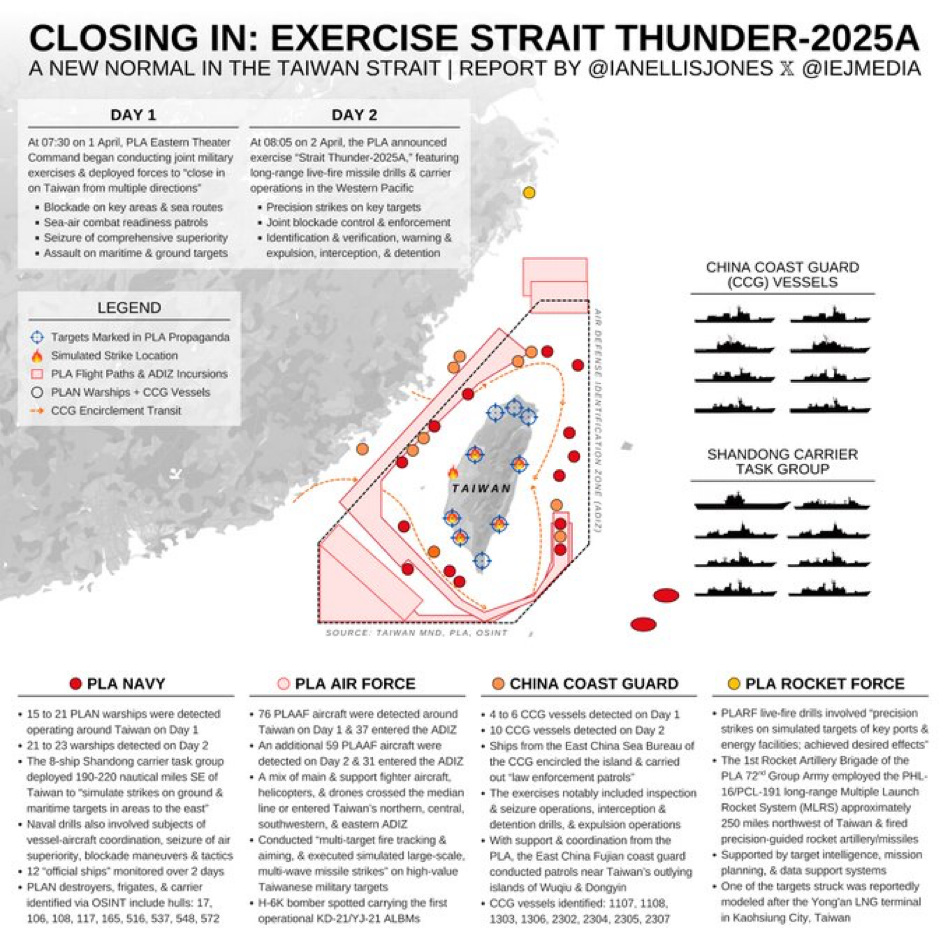
This mounting threat demands an urgent and resolute U.S. strategy—one that decisively eliminates strategic gaps, reinforces allied faith in America’s commitment, and projects unwavering resolve to deter CCP aggression. Taiwan must be the irreducible core of this strategy. It is no longer a secondary concern but the very linchpin of Indo-Pacific stability and America's global standing. The defense of Taiwan is not merely crucial for a free, open, and rules-based Indo-Pacific; it is fundamental to America’s own national security and its continued global and regional leadership.
“No one can stop China's reunification with Taiwan” – Xi Jinping
II. Why Taiwan Matters
Military Significance: Situated centrally within the first island chain, Taiwan directly connects key U.S. allies Japan and the Philippines. Strategically, it is the cornerstone of regional deterrence against CCP aggression. Defense analysts warn that losing Taiwan would allow the PLA to project power deep into Oceania, directly threatening U.S. territories like Guam and Hawaii. Thus, Taiwan is a crucial forward base whose protection is imperative for deterring CCP regional domination.
Economic Centrality: Taiwan's economic significance is global, anchored by its critical role in advanced semiconductor manufacturing. The Taiwan Semiconductor Manufacturing Company (TSMC) produces 90% of the world's most advanced microchip production—essential for technologies from AI to modern military hardware. A CCP takeover would give Beijing unacceptable leverage over global technology supply chains, potentially causing devastating economic shocks exceeding $10 trillion. Therefore, preserving Taiwan's economic autonomy is not only strategically prudent but an absolute imperative for U.S. national and economic security.
Democracy Beacon: Ideologically, Taiwan's thriving democracy challenges Beijing's authoritarian narrative about the incompatibility of democracy with Chinese culture. As a vibrant democratic society, Taiwan exemplifies the viability and resilience of democratic governance in Asia. Allowing Taiwan's democracy to fall under coercive pressure or military aggression would send a devastating message, emboldening authoritarian regimes such as North Korea and Iran, irreparably damaging U.S. credibility, and weakening global democracy.
The Taiwan Semiconductor Manufacturing Company (TSMC) produces 90% of the world's most advanced microchip production—essential for technologies from AI to modern military hardware
III. U.S. Strategic Objectives in the Indo-Pacific
To effectively address this critical strategic juncture, the United States must aggressively pursue five interconnected strategic objectives:
Establish Unambiguous Deterrence: Strengthen deterrence by demonstrating capability and resolve across military, cyber, economic, and informational domains.
Enhance Taiwan’s Resilience: Actively bolster Taiwan’s defense capabilities, political stability, and economic robustness. Supporting Taiwan’s economic diversification and strengthening international partnerships are essential to sustaining resilience against CCP pressure.
Forge Integrated Allied Capabilities: Strengthen and modernize alliances with Japan, the Philippines, Australia, and other regional partners to achieve seamless interoperability, multilateral burden-sharing, and superior joint operational readiness. These unified capabilities are the bedrock of effective deterrence.
Counter CCP Hybrid Threats: Aggressively expose, disrupt, and neutralize Beijing's hybrid warfare threats, including cyberattacks, disinformation, and economic coercion, thereby preventing incremental erosion of Taiwan’s security and resolve.
Deliver Clear Strategic Messaging: Maintain consistent, high-level strategic messaging (e.g., 'Strategic Ambiguity' vs 'Strategic Clarity') to ensure U.S. intentions are unequivocally understood by allies and adversaries alike, eliminating dangerous ambiguity and reducing the risk of miscalculations.
IV. A Holistic Strategy for Taiwan’s Defense
Building Forward-Deployed Deterrence with Allies: Enhanced U.S. basing agreements in the Philippines and Japan are a vital foundation for credible deterrence. The Enhanced Defense Cooperation Agreement (EDCA) has expanded strategic U.S. access to key Philippine bases near Taiwan, enhancing rapid deployment and logistics. Concurrently, Japan's historic defense reforms and close alignment with U.S. strategic priorities are transforming U.S. Marine Corps units in Okinawa into agile Marine Littoral Regiments capable of precision strikes across the Ryukyus Islands. These initiatives create a formidable multi-vector deterrence strategy, significantly complicating Chinese military planning and raising the cost of aggression.
Countering CCP’s Hybrid Tactics: The CCP’s gray-zone tactics—daily airspace incursions, persistent cyberattacks, disinformation campaigns, and economic coercion—systematically aim to erode Taiwan’s morale and international standing. Proactively countering these tactics requires persistent U.S. engagement, including joint maritime patrols with regional allies, deployment of Cyber Command teams to bolster Taiwan's cybersecurity, and proactive public information campaigns against Chinese disinformation. Simultaneously, deeper integration of Taiwan into resilient global economic frameworks reduces its vulnerability to Beijing’s economic coercion
Enhancing Deterrence: CSIS war game (2026) simulations vividly illustrate the catastrophic human and economic costs of a Taiwan conflict, underscoring deterrence as paramount. The United States must pre-position long-range precision fires and advanced munitions across the first island chain, stockpile anti-ship and air-defense systems at forward bases, and institutionalize robust multinational crisis planning with integrated command-and-control. Establishing a dedicated Taiwan Contingency Fund will enable rapid support for civil defense, logistics, and asymmetric capabilities. Regular, realistic joint exercises by Indo-Pacific Command (PACOM) with allied forces are vital for preparedness and deterrence credibility
Strategic Messaging and Narrative Warfare: Strategic communication must emphasize unwavering adherence to the One China Policy while unequivocally rejecting any forcible alteration of Taiwan's status. Predictable and consistent U.S. strategic messaging reinforces deterrence and reduces escalation risks. Framing Taiwan’s defense clearly as vital to international law, democratic governance, and global economic stability strengthens international support. Coordinated diplomatic messaging within forums like the Quad, G7, and NATO underscores the global stakes
The CCP’s gray-zone tactics—daily airspace incursions, persistent cyberattacks, disinformation campaigns, and economic coercion—systematically aim to erode Taiwan’s morale and international standing
V. Conclusion
The defense of Taiwan extends far beyond localized security interests; it represents a defining inflection point for the trajectory of the global order. If the CCP were to succeed in seizing Taiwan, whether through military invasion or coercive pressure, the credibility of U.S. alliances would be irrevocably undermined, critical global supply chains would be vulnerable to authoritarian manipulation, and the cause of democracy globally would experience a profound and potentially irreversible setback.
By unequivocally placing Taiwan at the core of a revitalized Indo-Pacific strategy, the United States demonstrates its unwavering commitment to regional stability and its readiness to lead in confronting escalating authoritarian challenges. A comprehensive strategy integrating a robust forward presence, the strategic deployment of asymmetric capabilities, seamless multilateral coordination with allies, and consistently clear strategic messaging provides the most effective means of influencing Beijing's strategic calculus and, ultimately, preserving peace and the open international order.
In this critical contest, true deterrence hinges not only on military might but also on moral fortitude, economic resilience, and unwavering psychological resolve. Success will be measured not by the eruption of conflict, but by its prevention: a free and democratic Taiwan, a stable and prosperous Indo-Pacific, and the continued vitality of a rules-based global order.