

Spiderweb: The Strike That Shattered the Myth of Russian Invincibility
Ukraine's Drone Strikes and Battlefield Resilience Expose the Myth of Russian Might: A Crumbling Economy, Collapsing Industry, and Soaring Casualties Reveal a Power in Freefall.

“…The ultimate test of statesmanship is what to do in the face of war…” ―Thatcher’s statecraft
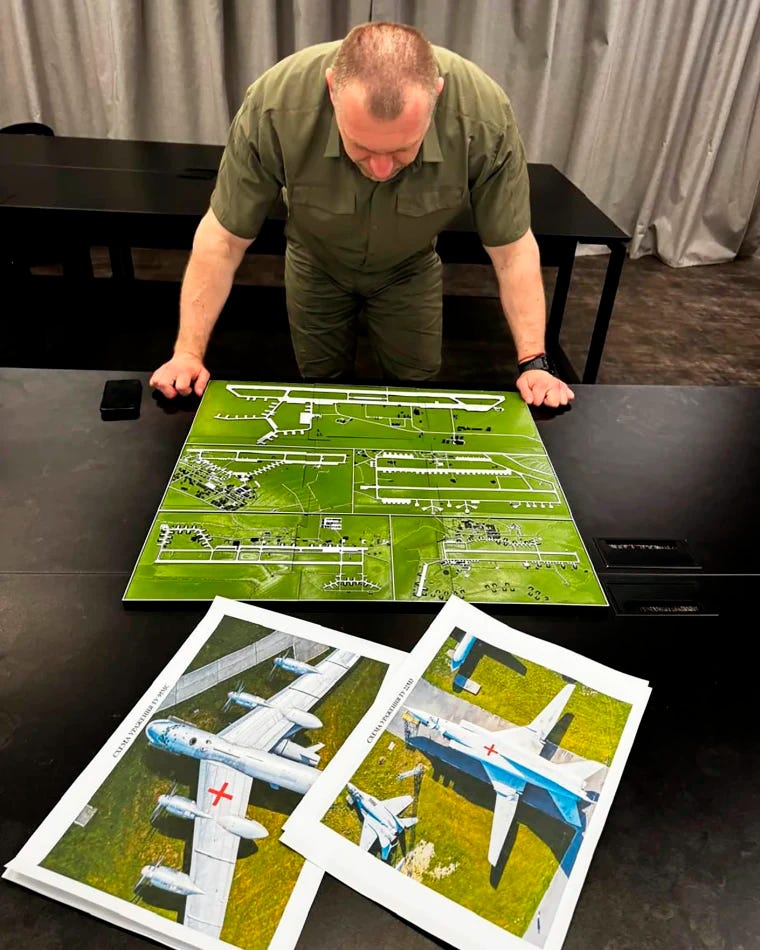
Ukraine’s daring drone strike on Russia’s strategic bomber fleet —codenamed ‘Operation Spiderweb’— has laid bare a stark truth: the Kremlin’s once-mighty military machine is not invincible, but hollow and vulnerable. Long feared as a formidable adversary of the West, Russia now stands exposed—hemorrhaging blood and treasure. Behind the bluster of propaganda and the brittle shell of nuclear deterrence lies a state that has bartered superpower prestige for pariah status. Its decline is no longer theoretical or gradual—it is visible, accelerating, and already well underway.
The Crumbling Illusion of Invincibility
When strategic bombers fall to relatively low-tech drones, the illusion of invincibility collapses with them
Despite the Kremlin’s nuclear saber-rattling, Russia has lost the strategic credibility that once made the world tremble. A stunning case in point: a third of its nuclear-capable strategic bombers were destroyed in a single surprise Ukrainian drone strike, causing $7 billion damage. This wasn’t the result of NATO airpower or a covert Western cyber strike, but a battlefield innovation by a country Russia assumed would crumble in days. These were not merely machines—they were intended to be pillars of Russia’s nuclear doctrine and strategic deterrence. When strategic bombers fall to relatively low-tech drones, the illusion of invincibility collapses with them.
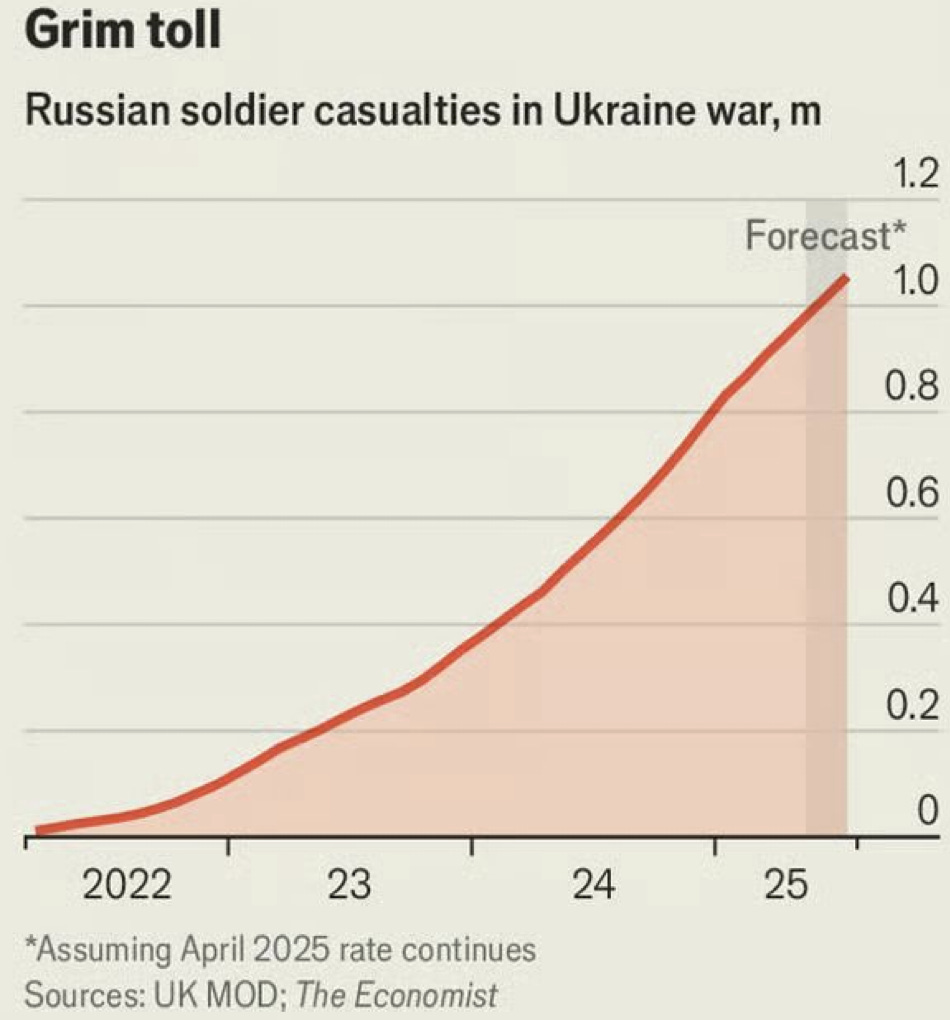
Moreover, the human cost of Putin’s imperial delusion is staggering. Nearly 1 million Russian troops have been killed or wounded in Ukraine. This figure represents not just military attrition, but a national trauma. It is the bleeding out of an entire generation to sustain an unprovoked war that has backfired spectacularly. These aren’t just numbers—they are fathers, sons, and citizens sacrificed on the altar of revanchist fantasy.
An Economy Adrift and a Nation Cannibalized
The so-called Eurasian superpower is increasingly dependent on one export: fossil fuel
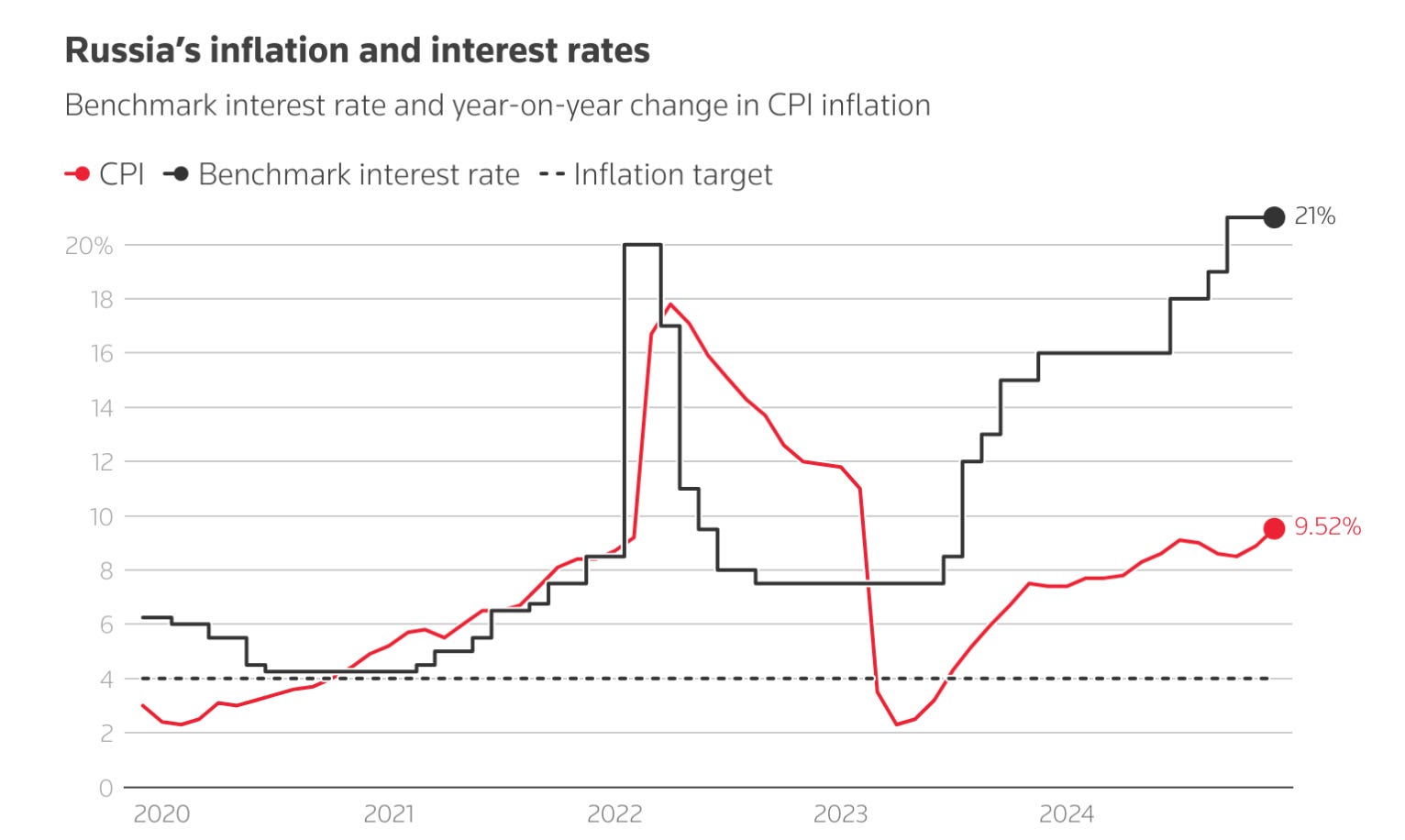
At home, the economic rot is accelerating as result of falling budget revenues and rising war expenditures. with 20% interest rate and 10% inflation, Russia’s industrial base is shrinking, layoffs are multiplying, and its war economy is cannibalizing what remains of consumer stability. The three-year war has become an economic black hole. Major corporations, once key drivers of domestic productivity, are downsizing. Sanctions, capital flight, and the exit of Western firms have battered the economy beyond easy recovery. The so-called Eurasian superpower is increasingly dependent on one export: fossil fuel—and even that lifeline now runs through China and India, under humiliatingly discounted terms.
The Self-Inflicted Wounds of MAD
Putin understands that a full-scale nuclear exchange would obliterate not only Russia, but the very empire of power and privilege he has spent decades building
This is no longer a superpower—it is a gas station with nukes, and even those it cannot credibly use. Putin is not a gambler; he is a cold, calculating autocrat who prizes control, luxury, and regime survival. He is no fanatic courting nuclear martyrdom. The doctrine of Mutually Assured Destruction (MAD) only functions when both sides have something left to lose—and Putin understands that a full-scale nuclear exchange would obliterate not only Russia, but the very empire of power and privilege he has spent decades building. Ironically, Russia has already MAD-ed itself—undermining its own deterrence through reckless military overreach, deepening diplomatic isolation, and escalating technological vulnerability.
Putin’s regime now depends on a coalition of authoritarian outliers to sustain its war machine and defy international isolation: Iranian Shaheed drones to terrorize Ukrainian civilians, North Korean munitions and troops to plug battlefield gaps, and Chinese buyers to keep its gas flowing. This is not strategic autonomy—it’s strategic dependency.
The West's Imperative: Resolve, Not Fear
bullying cannot redraw borders, and falsehoods will never outlast the truth
Yet, despite this unraveling, many in the West still entertain the myth of Russian might with undue caution. What this moment demands is not fear, but resolve. The West possesses the tools to contain Russia and bring its invasion to a decisive end—militarily, economically, and diplomatically. Unified sanctions, continued arms supplies, advanced air defenses, and long-range precision weapons for Ukraine can tilt the balance irreversibly. Russia cannot sustain a protracted conflict against a united, determined West. The idea that Putin holds all the cards is a mirage.
With sufficient political will, the West can dismantle the illusion of Russian resurgence, preserve Ukraine’s sovereignty and restore its territorial integrity, and send a message to authoritarian regimes worldwide: bullying cannot redraw borders, and falsehoods will never outlast the truth
Conclusion
History will not remember Russia’s war of aggression against Ukraine as an act of triumph—but as the twilight performance of a power that once was, brought down not by the West’s fear, but by its own overreach.
It’s time the West stops treating Russia like a bear and sees it for what it is: a wounded beast clinging to gas pipelines and obsolete missiles, desperate for relevance in a world that’s moving on without it. As George Kennan warned in his “Long Telegram,” the Soviet Union, and by extension its successor state, is "impervious to the logic of reason" but "highly sensitive to the logic of force," retreating "when strong resistance is encountered at any point." That same logic applies to Putin’s Russia today.