

Tehran-Caracas Connection: How IRGC and Hezbollah Solidify Maduro’s Regime
What happens when Iran extends its reach beyond the Middle East and into the U.S.’s backyard?

I. Introduction
Iran’s growing influence in Venezuela, driven by the expeditionary wing of the Islamic Revolutionary Guard Corps (IRGC), the Qods Force, has become a key pillar of Nicolás Maduro’s regime. More than a diplomatic partnership, Iran provides advanced military training, cutting-edge technology, and expertise in cyber warfare, solidifying Maduro’s control and giving Iran a strategic foothold in Latin America—a region vital to U.S. national security.
A proxy of the Qods Force, Hezbollah’s narco-terror network in Venezuela help deepen this alliance, enabling Tehran and Caracas to undermine U.S. influence and destabilize the region. Together, Iran and Hezbollah are not only fortifying Maduro’s regime but also reshaping Latin America's geopolitical landscape, directly threatening U.S. interests and opening new fronts for conflict in the Western Hemisphere.
II. Iran Playbook
Iran's strategy in Venezuela closely mirrors its operations in Syria and Iraq, deploying a mix of military, economic, and ideological tools to expand its influence. In Syria, Iran has bolstered Assad’s regime through the IRGC and Hezbollah, using proxy forces to cement military intervention. Similarly, in Iraq, Shia militias aligned with the IRGC, operating under the Popular Mobilization Forces, have effectively turned Iraq into an Iranian client state. These tactics—propping up authoritarian regimes, using proxies like the Houthis to attain political objectives, and spreading disinformation to shape public perception—are now being replicated in Venezuela, where Iran is strengthening Maduro’s hold on power. Across these regions, Iran exploits instability and anti-Western sentiment to entrench its dominance, reshape local politics, and challenge the U.S.-led global order. This strategic playbook highlights Tehran’s goal of extending its influence beyond the Middle East into Latin America through asymmetric warfare, ideological alignment, and economic exploitation.
III. Iran’s Instruments of Influence
Ideological Alignment
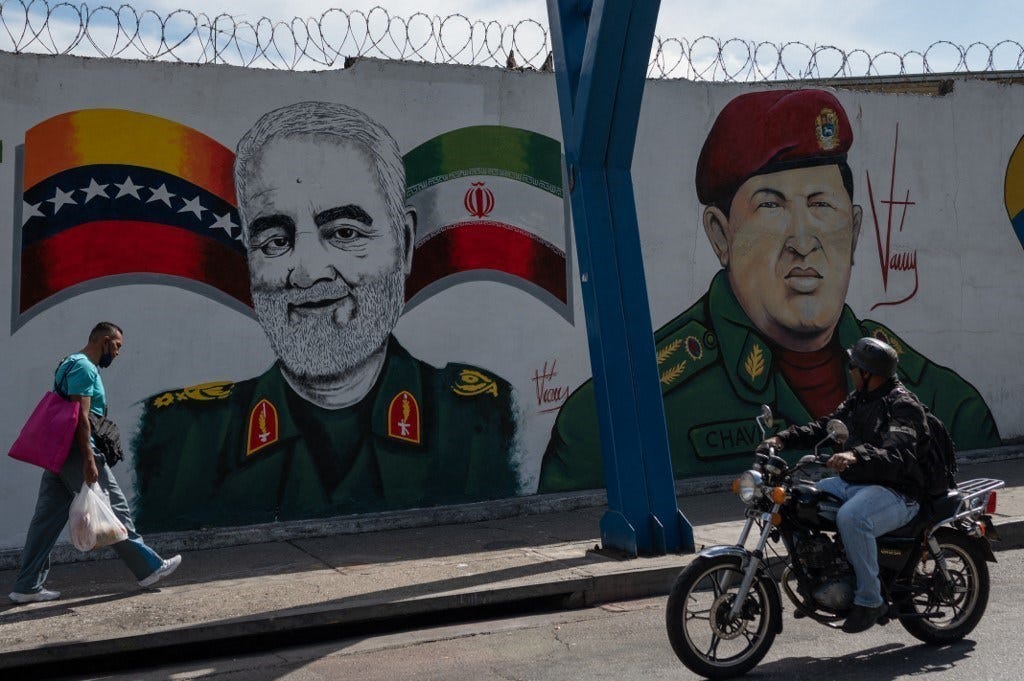
Former Venezuelan President Hugo Chávez forged a strong ideological bond between Venezuela and Iran through their shared anti-U.S. stance. A vocal critic of U.S. imperialism, Chávez saw Iran as a strategic ally to counterbalance American influence in Latin America. Under his leadership, Venezuela aligned with Iran in a global “anti-imperialist” movement, opposing Western intervention and neoliberalism.
This alliance was rooted in a shared opposition to neoliberalism and Western dominance. Chávez praised Iran’s defiance of U.S. sanctions, while Iranian President Mahmoud Ahmadinejad viewed Venezuela as a key partner in spreading anti-U.S. narratives across Latin America. This alliance positioned both nations as defenders of sovereignty against perceived U.S. interventionism, and Chávez’s ideological legacy continues to shape the Iran-Venezuela relationship today, fueling anti-Western movements and challenging U.S. interests in the region.
Hezbollah’s Narco-Terror Network
As a key instrument of Iran’s asymmetric tactics in Latin America, Hezbollah, considered a terrorist organization by the United States, operates a vast narco-terror network across the region to support Tehran’s strategic objectives, including bolstering Nicolás Maduro’s regime in Venezuela. Embedded deeply within Venezuela’s security and economic systems, Hezbollah engages in organized crime, drug trafficking, and money laundering, particularly in the tri-border area between Argentina, Brazil, and Paraguay. These illicit activities generate significant revenue that funds Hezbollah’s operations. According to The DEA, estimated Hezbollah’s annual proceeds from drug trafficking alone to be approximately $400 million. Hezbollah is also believed to collaborate with criminal organizations such as the Revolutionary Armed Forces of Colombia (FARC) and train armed groups aligned with Maduro, including Venezuela’s “colectivos,” paramilitary groups used to suppress dissent. By supporting the Maduro regime and expanding Iran’s influence, Hezbollah plays a central role in Tehran’s subversive and destabilizing activities across Latin America. These operations align with Iran’s broader strategy of using Venezuela as a strategic hub to undermine U.S. interests and strengthen anti-Western regimes throughout the region.
Economic and Energy Cooperation
Sanctions Evasion
Iran has played a critical role in helping Venezuela evade U.S. sanctions, particularly in the energy sector. As Venezuela’s oil refining capacity deteriorated due to sanctions and economic mismanagement, Iran stepped in with essential support. In 2020, Iranian tankers like the Fortune delivered over a million barrels of gasoline to Venezuela, helping the country avoid crippling fuel shortages. Iranian engineers were also sent to repair refineries, such as the El Palito facility, restoring some of Venezuela’s refining capabilities. To avoid detection and further sanctions, Iran and Venezuela employed strategies like renaming and re-flagging ships, switching off transponders mid-voyage, and using alternate shipping routes. These methods allowed both nations to continue trading oil and fuel, undermining U.S. efforts to economically isolate them and strengthening their strategic partnership.
Joint Ventures and Investments
Iranian companies, many connected to the Islamic Revolutionary Guard Corps (IRGC), have established joint ventures with Venezuelan state enterprises in critical sectors such as agriculture, mining, and construction. For example, Iran’s National Oil Refining and Distribution Company (NIORDC) has provided essential refinery parts and technology to help Venezuela revive its oil refineries, which have suffered due to sanctions and mismanagement. Additionally, Iran's state-owned petrochemical companies have signed agreements with Venezuela to collaborate on the production of chemicals and fuel. In the mining sector, Iran has gained access to Venezuela’s strategic minerals, which are vital for its missile programs. These ventures not only offer financial lifelines to Nicolás Maduro’s regime but also allow Iran to secure strategic footholds in Latin America, bolstering its influence. Through these efforts, both nations have been able to circumvent U.S. sanctions, with Iranian tankers delivering fuel to Venezuela and new shipping routes and joint maritime companies facilitating trade.
Military and Security Collaboration
The Islamic Revolutionary Guard Corps (IRGC) has played a pivotal role in supporting the Maduro regime by providing military training, intelligence support, and strategic guidance. This includes aiding the Venezuelan armed forces in counterintelligence operations, surveillance, and the suppression of internal dissent. For example, the IRGC has assisted in developing Venezuela's counterintelligence capabilities, helping the government monitor opposition groups and suppress protests. Iranian operatives have reportedly trained Venezuelan military personnel in drone usage, surveillance, and cyber-espionage techniques, further entrenching the regime’s grip on power. The IRGC’s involvement extends to cyber and asymmetric warfare, where Iran has helped Venezuela build sophisticated surveillance systems for monitoring opposition movements, including tracking dissent on social media and maintain control amid political and economic instability.
Diplomatic and Propaganda Support
International Solidarity
Iran has been a steadfast supporter of Venezuela on the global stage, consistently defending Nicolás Maduro’s government in international forums and condemning attempts to “delegitimize” his rule. For instance, Iran has repeatedly opposed U.S. sanctions and denounced efforts by Western nations to isolate Venezuela, framing them as imperialist moves. Tehran's diplomatic backing, including vocal support in the United Nations and other international bodies, has been crucial in helping Venezuela resist international isolation and maintain its sovereignty. This political solidarity has not only reinforced Maduro’s position domestically but has also enabled Venezuela to maintain crucial alliances despite mounting global pressure.
Propaganda and Media Influence
Iranian state media, particularly Hispan TV, play a key role in promoting narratives that support Nicolás Maduro’s regime, portraying Venezuela as a victim of U.S. aggression and highlighting the successes of Iranian-Venezuelan cooperation. This media strategy forms part of a broader effort to shape regional opinion, positioning both regimes as defenders against imperialism. In addition to traditional broadcasting, Hispan TV, Venezuela’s Telesur and Russia’s RT en Español coordinate their messaging across social media platforms like Twitter, Facebook, Instagram, and WhatsApp chat groups, creating a rapid amplification of pro-Iran and pro-Maduro narratives. These platforms collaborate to push targeted content from smaller outlets to mainstream media, capitalizing on the region's anti-U.S. sentiment.
The dissemination of pro-Iran and pro-Maduro narratives relies heavily on well-funded influencers, such as tuiteros, who strategically tailor these messages to resonate with diverse audiences. Hispan TV consistently frames U.S. sanctions on Venezuela as imperialist actions, positioning both Iran and Venezuela as victims of Western oppression. Meanwhile, Russia’s RT en Español amplifies these themes, integrating local issues to craft a broader anti-U.S. discourse that rapidly spreads across social media platforms. By reframing regional protests and economic instability as results of U.S. interference, these outlets deflect blame from local regimes and external partners like Iran. This tactic not only reinforces their strategic influence in the region but also leverages historical grievances against U.S. intervention, making these narratives particularly potent in Latin American countries.
IV. Consequences and Implications
Iran’s support for Nicolás Maduro, through the IRGC and Hezbollah, has had significant destabilizing effects across Latin America. This alliance introduces covert operations, intelligence gathering, and the potential for militarization, posing direct threats to neighboring countries like Argentina, Colombia, and Peru. By providing military training, intelligence, and strategic guidance, Iran enables Maduro to maintain power through repression, further undermining democratic institutions and heightening regional insecurity.
Hezbollah’s operational capabilities and close ties to Iran also represent a substantial security threat to the region. While Hezbollah has not carried out terrorist attacks in Latin America recently, its history of terrorism—including the 1994 bombings of the Israeli embassy and the Argentine Mutual Israelite Association (AMIA) Jewish community center in Buenos Aires—highlights the potential danger. Its extensive narco-terror network throughout Latin America not only advances Iranian interests but also increases the likelihood of asymmetric warfare, further destabilizing the region and contributing to broader instability.
On a global scale, this growing alliance between Iran, Venezuela, and actors like Russia and Cuba threatens U.S. interests, increasing tensions not only in Latin America but also in U.S.-Latin American relations. The destabilization of democratic regimes in Latin America through Iranian and Hezbollah activities could have far-reaching consequences for global security, potentially leading to increased conflict and a weakening of U.S. influence in the Western Hemisphere.
V. Conclusion
Iran’s growing influence in Venezuela presents an urgent and direct threat to U.S. interests in Latin America, reshaping the region’s geopolitical landscape. Tehran's alliance with Caracas and Hezbollah not only undermines democratic institutions but also shifts the regional balance of power. By establishing Venezuela as a strategic hub, Iran has extended its reach far beyond the Middle East, eroding U.S. influence in a traditionally American sphere. The IRGC and Hezbollah have transformed Venezuela into a base for intelligence gathering, military training, and illicit activities such as drug trafficking, which help advance Tehran’s broader ambitions in the region. This network destabilizes neighboring countries, including Colombia, Peru and Brazil, while heightening tensions with the U.S. and its European allies.
The immediate risks include asymmetric warfare, cyber-espionage, and increased militarization, all compounded by disinformation campaigns that weaken public trust in democratic governance. To counter this rising threat, the U.S. must act swiftly, prioritizing coordinated diplomatic, military, and economic measures. Reinforcing regional security and protecting Latin American democracies from Iranian influence is critical to maintaining stability and ensuring U.S. strategic interests in the Western Hemisphere. Addressing these threats will require coordinated international action, before Iran's foothold becomes further entrenched:
Short-Term Strategies:
Dismantling Hezbollah’s Networks: The Drug Enforcement Administration (DEA) ought to play a leading and vital role in dismantling Hezbollah’s extensive financial and criminal networks operating in the tri-border areas (TBA) of Argentina, Brazil, and Paraguay. This effort requires a coordinated focus on cross-border smuggling, arms trafficking, and illicit financial activities that fuel Hezbollah’s operations and expand Iran’s influence in the region. The DEA, through initiatives like Project Cassandra, has already exposed Hezbollah’s deep involvement in drug trafficking and money laundering for cartels, generating millions in illicit revenue. By partnering with the DEA and utilizing its expertise in tracking and dismantling these networks, Argentina, Brazil, and Paraguay can significantly weaken Hezbollah’s operations and disrupt its financial pipelines. The DEA’s proven ability to investigate and bring down these transnational criminal organizations will be critical to cutting off Hezbollah’s financial lifelines and crippling its broader influence in Latin America.
Strengthening Military and Security Cooperation: Leveraging its expertise in intelligence-sharing, cybersecurity, and counter-narcotics, USSOUTHCOM (United States Southern Command) is pivotal in dismantling the illicit networks that support Tehran’s subversive activities, including those of Hezbollah and the IRGC. With its resources and operational capabilities, USSOUTHCOM can lead joint security operations to secure borders and neutralize criminal organizations in key regions like the Tri-Border Area (TBA). By partnering with local governments such as Argentina, Brazil, and Paraguay, USSOUTHCOM will ensure these actions are comprehensive and effective, bolstering regional security and stability while countering Iran’s malign influence.
Curbing Iranian Influence: The U.S. and its regional allies should leverage the Organization of American States (OAS) as a platform for regional cooperation, uniting member states in a collective response to counter Iran's growing influence in Latin America. The OAS is uniquely positioned to foster dialogue, build consensus, and reinforce democratic governance across Latin America. By bringing together countries like Argentina, Chile, and Peru, which oppose Maduro’s regime, the OAS can facilitate the development of unified strategies that counter Iranian influence and protect vulnerable nations from subversive activities. The OAS must act swiftly to strengthen regional institutions, promote transparency, and ensure that diplomatic efforts are aligned to safeguard Latin America’s political stability against foreign malign influence.
Long-Term Strategies:
Countering Disinformation: Iran and Russia’s coordinated disinformation campaigns are actively shaping public opinion across Latin America, particularly in countries with a strong skepticism toward Western influence. These campaigns aim to undermine democratic institutions and erode public trust by positioning Iran, Venezuela, and their allies as victims of Western imperialism. To effectively counter this narrative, regional governments must implement proactive, fact-based messaging strategies, while collaborating with international partners to enhance media literacy and build resilience against propaganda. Exposing Iran’s complicity in Maduro’s human rights abuses and corruption will help discredit these manipulative narratives. At the same time, highlighting U.S. humanitarian aid efforts can counteract anti-Western sentiments, helping to inoculate populations against the disinformation tactics employed by Iran and Russia.
Strengthening Democratic Institutions: One of the key goals of Iran, Hezbollah, and Russia is to destabilize Western-aligned democracies in Latin America. Strengthening democratic institutions—through rule of law reforms, anti-corruption measures, and electoral integrity initiatives—will fortify countries against foreign interference. Supporting civil society groups, independent media, and political reforms is essential to ensuring that Latin American nations remain resilient to foreign subversion and manipulation.
In sum, Iran's partnership with Venezuela is reshaping the power dynamics in Latin America, contributing to a “multipolar” world order that directly challenges U.S. influence. Addressing this evolving threat requires a comprehensive and coordinated response that integrates diplomatic, military, and informational strategies. By tackling these interconnected challenges, regional and international partners can significantly weaken the destabilizing influence of Iran, Hezbollah, and Russia in Latin America, while reinforcing democratic governance and regional security. This collaboration also signals a broader effort to reshape global power structures, as seen in geopolitical events like the Ukrainian war.