

The Dragon’s Cloak: Inside MSS Shadow War on America
CCP’s MSS is waging a multi-domain hybrid warfare to destabilize America from within and undermine its global leadership through espionage, sabotage, coercion, and ideological warfare.

“The supreme art of war is to subdue the enemy without fighting” —Sun Tzu’
I. Introduction
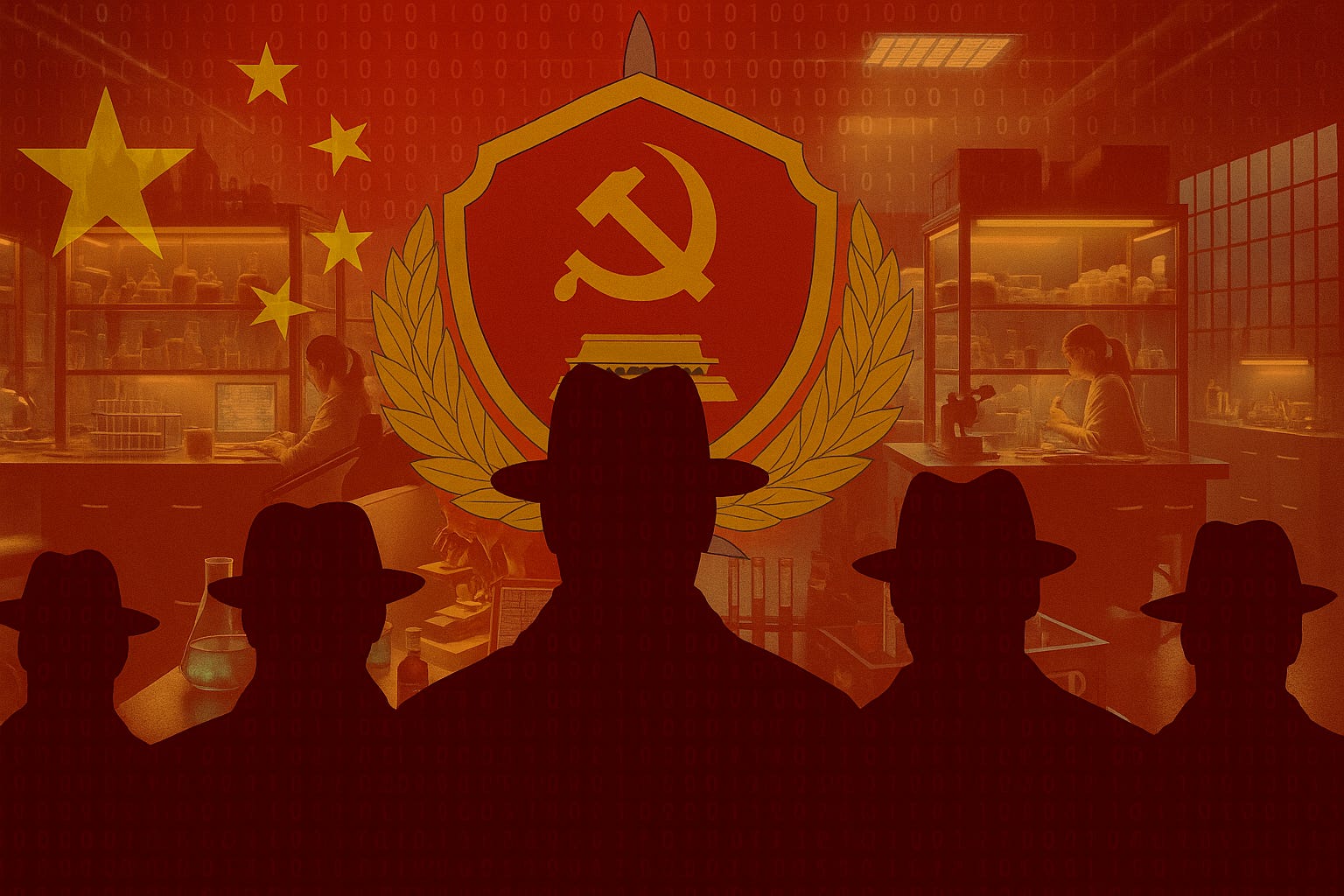
As Washington reassesses its strategic posture toward China, a more insidious threat is already embedded deep within the fabric of American society—not on battlefields or in contested airspace, but in server rooms, boardrooms, campuses, and communities. At the center of this silent offensive stands the Ministry of State Security (MSS), China’s primary intelligence and political warfare arm. Now reportedly the largest and most active spy agency in the world, the MSS operates with sweeping reach and intensity, representing what FBI Director Christopher Wray has described as the most significant counterintelligence threat facing the United States.
Rooted in the doctrine of Unrestricted Warfare, as articulated by Chinese military theorists Qiao Liang and Wang Xiangsui, the MSS wages a campaign not of bullets and bombs, but of paralysis and perception.
It targets the extended domain—cyberspace, academia, civil society—weaponizing cyber intrusions, elite capture, academic infiltration, fentanyl trafficking, and diaspora surveillance to undermine America’s democratic institutions, erode its global leadership, and neutralize resistance to Beijing’s ascent.
This is not traditional espionage; it is ideological warfare waged by asymmetric means, orchestrated by the Chinese Communist Party (CCP)’s central apparatus and executed through a diffuse network of state bureaus, front companies, consulates, and seemingly private actors. The MSS’s reach now penetrates nearly every dimension of American life, demanding not just technical defenses, but a fundamental strategic reckoning.
II. MSS at the Helm of Political Warfare
Established in 1983, China’s Ministry of State Security (MSS) functions as the CCP’s principal civilian intelligence agency, tasked with protecting the regime through domestic counterespionage and the global acquisition of strategic intelligence. Anchored in a central ministry and supported by a network of provincial State Security Departments (SSDs), the MSS commands a vast operational footprint that extends deep into foreign institutions. Operating primarily under official cover, it conducts foreign intelligence through human recruitment (HUMINT), cyber intrusions, and industrial espionage. Among its most consequential influence operations was the global dissemination of the “China’s peaceful rise” narrative, in which MSS operatives—masquerading as scholars and diplomats—cultivated relationships with academics, policymakers, and thought leaders to lull democratic societies into complacency.
Under China’s 2017 National Intelligence Law, all citizens and organizations are legally compelled to support and cooperate with state intelligence efforts, particularly in sensitive sectors.
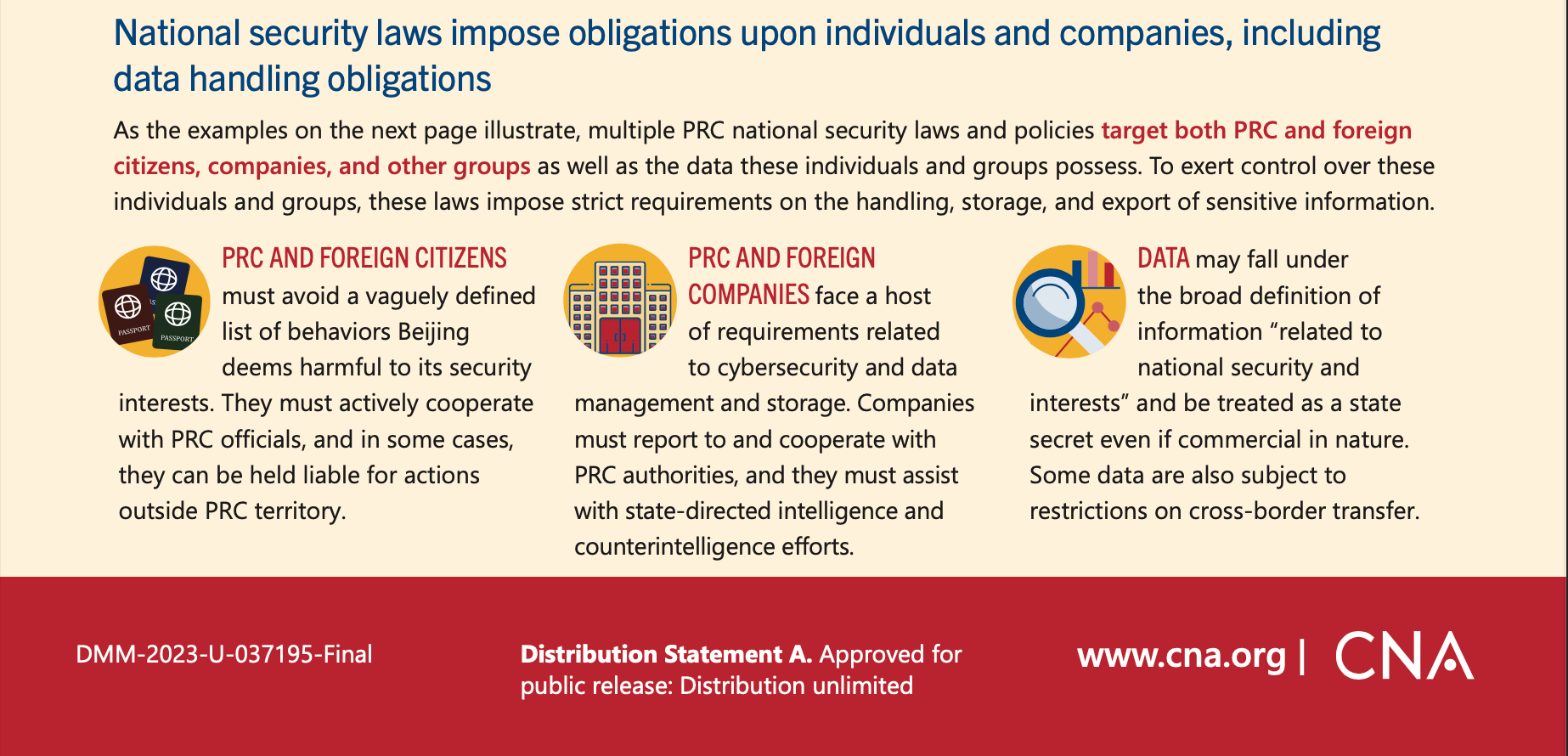
This sweeping directive effectively turns the Chinese public and corporate landscape into an extension of the CCP’s intelligence apparatus. State-affiliated companies like Huawei and TikTok, while promoting China’s economic interests, also facilitate global data collection and influence operations. At the same time, Beijing leverages diaspora networks to amplify pro-CCP narratives and gather intelligence across open Western societies—exploiting democratic transparency and posing significant challenges to attribution and counterintelligence efforts.
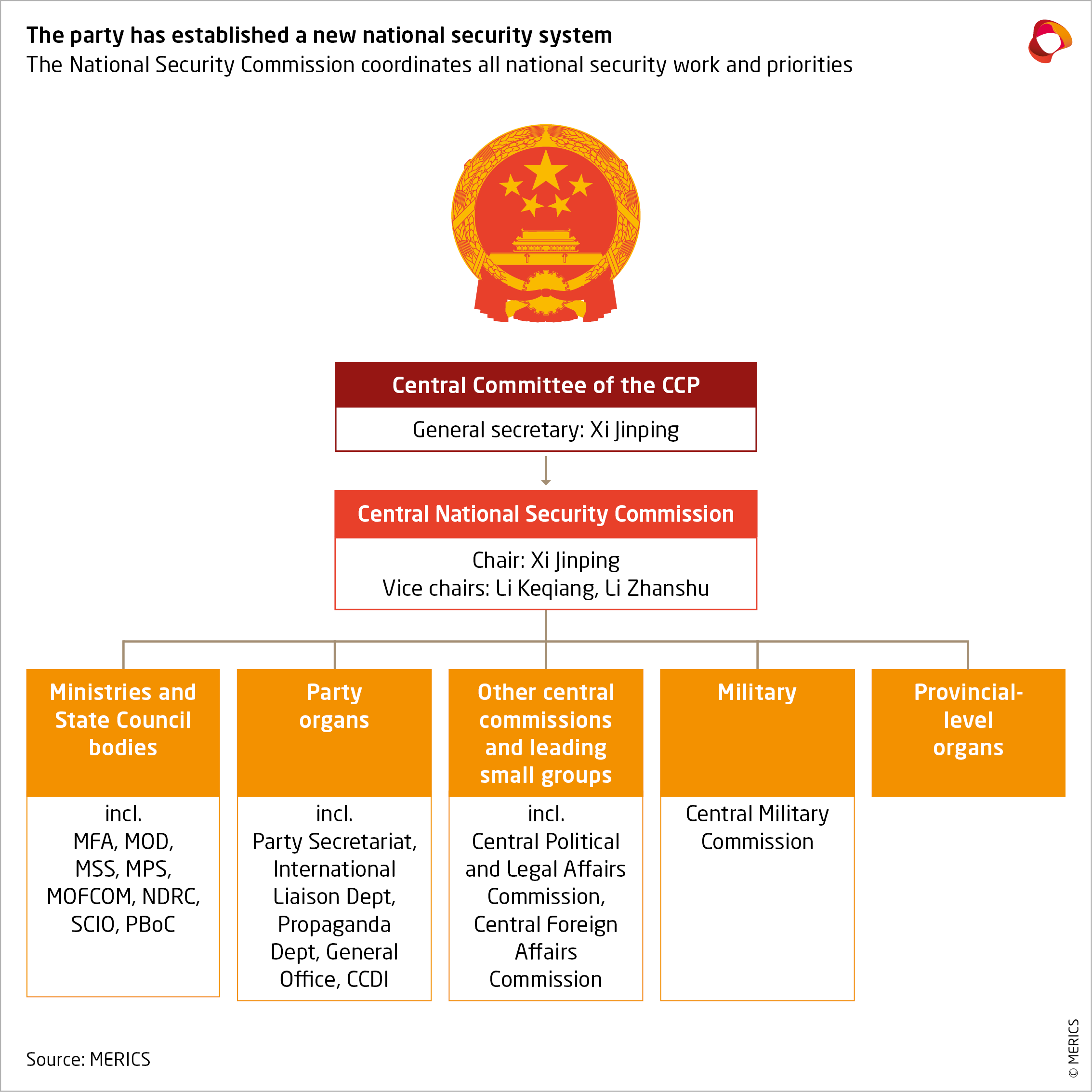
The MSS operates in concert with the People’s Liberation Army (PLA)’s intelligence branches and the United Front Work Department (UFWD), forming a tightly integrated, whole-of-state ecosystem for espionage and influence. While the PLA focuses on military assets, the MSS casts a broader net—prioritizing political, technological, and economic targets vital to China’s ascent. Its strategic mission is unambiguous: to accelerate China’s rise by relentlessly acquiring advanced foreign technologies, shaping global narratives, and eroding resistance to Beijing’s authoritarian model. The MSS is not just a spy service—it is an agent of systemic transformation, shaping global environments to favor CCP dominance. As FBI Director Christopher Wray has warned, it leaves no stone unturned in its campaign to undermine democratic institutions and tilt the global balance of power in China’s favor.
III. The Doctrine Underpinning MSS Mission
At the heart of China’s hybrid warfare is not opportunism but a potent and codified ideology: Xi Jinping Thought. This doctrine—melding Leninist centralism, Han ethno-nationalism, and the pursuit of “national rejuvenation”—serves as the ideological engine driving the Chinese Communist Party’s (CCP) strategy to reshape the international order in its authoritarian image. Within this framework, the Ministry of State Security (MSS) is not merely an intelligence agency but the operational spearhead of Xi’s doctrine of “comprehensive national security,” a paradigm that reimagines every sphere of engagement—technological, economic, cultural, academic, and diplomatic—as a battlefield for CCP dominance and ideological expansion.
Viewed through this ideological lens, hacking is rebranded as “strategic rebalancing,” elite co-optation as “narrative correction,” and transnational repression as “national defense.”
This is not a Cold War redux nor a clash of empires, but a new form of conflict: asymmetrical, unconventional, and embedded within the architecture of open societies. Where democracies find strength in transparency, legal norms, and pluralism, the MSS sees vulnerability—entry points for infiltration, manipulation, and systemic subversion.
Xi’s strategy is methodical: to erode the liberal order from within and reassert Beijing’s primacy without firing a shot. At its core are four interlocking ambitions—annexing Taiwan, severing U.S. access to semiconductors, dominating the electric vehicle market, and surpassing the United States in artificial intelligence—an integrated blueprint to dismantle American hegemony and rewire the global order to serve China’s authoritarian ascent.

IV. The MSS Toolkit of Hybrid Warfare
Cyber Espionage
Cyber espionage lies at the core of the MSS’s operational playbook, executed through a network of state-sponsored Advanced Persistent Threat (APT) groups like APT10, APT40, Volt Typhoon, and Flax Typhoon. These actors have systematically infiltrated managed service providers, defense contractors, research institutions, and critical infrastructure—from semiconductor hubs to the U.S. electric grid. These are not isolated breaches for simple data theft; they are calculated efforts to establish digital beachheads that could be activated for strategic disruption during geopolitical crises, especially in scenarios involving Taiwan. Campaigns such as APT10’s “Cloud Hopper,” which exploited third-party vendors to access Western tech ecosystems, and APT40’s targeting of naval and biomedical research, underscore the MSS’s dual ambition: accelerating China’s technological ascent while degrading U.S. advantage in critical sectors.
These operations are not cybercrime—they are instruments of statecraft. China has fused cyber warfare with industrial policy, transforming the MSS into a digital vanguard of Beijing’s global ambitions.
The exposure of Volt Typhoon in 2023 revealed MSS-linked access to U.S. civilian infrastructure, potentially enabling coordinated sabotage, not just surveillance. Meanwhile, a shadow ecosystem of hacking-for-hire actors—operating with plausible deniability but strategic alignment—complicates attribution and dulls deterrence. Collectively, these operations reflect a deliberate doctrine of asymmetric competition in which disruption is favored over destruction, and dominance in the digital sphere yields not only economic leverage but also coercive power on the global stage.
Infiltrating and Exploiting Insider Access
Complementing its cyber capabilities, the MSS has constructed an expansive human intelligence (HUMINT) network to infiltrate America’s scientific, political, and institutional spheres. Its recruitment strategy is wide-ranging, targeting engineers, academics, business leaders, and even former U.S. intelligence personnel. The breadth of this campaign is evident in the FBI’s active China-related counterintelligence cases across all 56 field offices. High-profile cases reveal the MSS’s patience and precision: Xu Yanjun, the first MSS officer extradited to the U.S., used academic cover to steal GE Aviation’s jet engine technology; Ji Chaoqun sought to infiltrate the U.S. Army Reserves; and Alexander Yuk Ching Ma, a former CIA officer, was co-opted to betray sensitive information. These are not anomalies—they are manifestations of a sustained strategy to exploit insider access and intellectual vulnerability.
Yet MSS operations stretch beyond classic espionage into the realm of elite capture and political grooming. The Fang Fang case highlighted years-long cultivation of California political figures. Investigations at Stanford uncovered coercive MSS-linked funding to probe sensitive AI research. Rebranded Chinese language programs continue to operate as quiet channels for influence in American educational institutions. At the state level, the case of Linda Sun —an aide to New York’s governors Kathy Hochul and Andrew Cuomo accused of acting as a secret agent of the Chinese government —demonstrates how the MSS exploits soft governance environments to shape U.S. policy from the grassroots.
Interwoven with this architecture is another insidious threat: China’s role in fueling the U.S. fentanyl crisis. By supplying precursor chemicals to Mexican cartels, Beijing exacerbates American social decay—whether through malign neglect or deliberate design—transforming a public health emergency into yet another vector in its multidimensional campaign of erosion.
The MSS has also been linked to covert real estate acquisitions aimed at placing Chinese entities near critical infrastructure, particularly U.S. military installations. These purchases, often masked as legitimate business ventures, align with the MSS’s broader strategy of embedding operatives across sectors to facilitate espionage and influence. A notable example is GNC, the vitamin and supplement retailer operating 85 stores on U.S. military bases—owned by Harbin Pharmaceuticals, a partially state-owned Chinese company with direct ties to the Chinese Communist Party (CCP).
Shaping Public Discourse
The MSS functions as a central architect of China’s information warfare strategy, operating in close coordination with the CCP’s propaganda apparatus and the United Front Work Department (UFWD). Through campaigns like DRAGONBRIDGE—an online effort to influence the 2022 U.S. midterms—the MSS has shown a growing capacity to manipulate digital ecosystems, spread disinformation, and erode public trust in democratic institutions.
Though early operations were often unsophisticated, they reflect a deeper strategic objective: reshaping global narratives to elevate Beijing’s image while silencing dissent.
These efforts extend beyond cyberspace, encompassing elite co-optation, media manipulation, and the quiet insertion of pro-CCP perspectives into academic and policymaking spheres. The Gal Luft case underscores how the MSS, often acting through UFWD proxies, weaponizes relationships, funding, and access to steer foreign discourse in subtle but consequential ways.
Equally troubling is the MSS’s role in transnational repression. Under initiatives like Operation Fox Hunt, it has targeted Chinese dissidents, whistleblowers, and human rights advocates on U.S. soil—deploying surveillance, intimidation, and coercion to extend authoritarian reach beyond China’s borders. These operations not only violate international norms and U.S. sovereignty but also serve as warning shots to broader diaspora communities. Unlike Russia’s often chaotic and bombastic disinformation campaigns, China’s influence operations are methodical, narrative-driven, and calibrated for deniability—focused on reputation management, inducing foreign self-censorship, and normalizing CCP legitimacy. Yet as strategic stakes rise, the MSS has begun adopting more aggressive tactics, signaling a readiness to intensify psychological and political warfare when Beijing’s interests demand it.
Weaponization of Talent Pipelines
The MSS has systematically weaponized the openness of Western academic and research ecosystems, transforming global talent flows into covert pipelines for technology acquisition and strategic influence. Programs like the Thousand Talents Plan (TTP), ostensibly created to reverse brain drain, have in practice functioned as recruitment platforms—drawing foreign scientists and scholars into undisclosed relationships with Chinese state-linked entities. Often operating behind the scenes, the MSS targets high-value research domains and cultivates key individuals for clandestine collaboration with Chinese institutions.
The case of Dr. Charles Lieber at Harvard illustrates how even elite researchers can be co-opted into facilitating knowledge transfers with profound implications for U.S. national security and competitiveness.
Complementing these efforts, Confucius Institute (CI)—initially branded as cultural exchange centers—have faced mounting scrutiny for their role in soft surveillance and influence operations, leading to widespread closures on American campuses. Meanwhile, MSS-linked front companies and seemingly benign research partnerships have been used to obscure technology theft, as evidenced by the now-shuttered Chinese consulate in Houston, publicly identified as an espionage hub. This deliberate exploitation of academic transparency and institutional trust reflects a broader MSS strategy: fusing intelligence collection with soft-power platforms to subvert the very systems that foster global scientific collaboration. Protecting U.S. innovation now demands not only vigilance but a recalibration of how open research environments defend against foreign state exploitation.
V. A Strategic Response to MSS’s Subversion
Confronting the MSS’s multi-domain offensive requires a doctrine as expansive and sophisticated as the threat itself. The first imperative is exposure—publicly identifying MSS officers, dismantling front companies, attributing cyber intrusions, and illuminating covert influence campaigns. Yet defensive measures must go beyond cyberspace. Key targets in the MSS’s infiltration playbook—universities, research institutions, diaspora communities, think tanks, and local governments—must be systematically fortified. This is not simply a matter of infrastructure resilience, but of institutional awareness and whole-of-society readiness.
But defense alone is insufficient. This is not a conventional geopolitical rivalry—it is a systemic confrontation. The CCP’s hybrid warfare thrives in ambiguity, exploiting democratic openness and reluctance to recognize influence operations as acts of aggression. The MSS is not merely stealing secrets—it is actively reshaping democratic systems from within. Through cyber intrusions, elite capture, transnational repression, and disinformation, it seeks to distort discourse, suppress dissent, and erode liberal norms. These attacks exploit not just digital vulnerabilities, but the very openness of democratic society. The U.S. response must move from disruption to deterrence, aligning legal action, public attribution, allied coordination, and ideological resolve to protect not only national security secrets, but the democratic foundations they are meant to serve.
VI. Conclusion
The shadow war waged by the CCP’s MSS is not a peripheral concern—it is the linchpin of the CCP’s grand strategy to erode American power from within. This is not a war of missiles and tanks, but one fought in boardrooms, laboratories, campuses, and digital backdoors—through cyber intrusions, elite capture, disinformation, and the repression of dissent. It is undeclared, yet deeply destructive.
At its core lies a potent ideology—Xi Jinping Thought—weaponized through the doctrine of “comprehensive national security,” which elevates subversion into statecraft. Understanding the MSS’s methods and ambitions is essential—but insufficient. Confronting this threat requires a unified national strategy that combines robust counterintelligence, cyber resilience, legal accountability, and ideological clarity. Our universities, research labs, and public institutions must be protected as rigorously as our military assets.
This is not merely a battle over information—it is a contest over who defines truth, sovereignty, and global legitimacy. The MSS is not merely stealing secrets; it is systematically reshaping the world in Beijing’s authoritarian image. As former diplomat Jim Lewis warned, “When a regime represses its own citizens, it will eventually repress yours.” The MSS’s reach is not confined to China’s borders—it is global, calculated, and corrosive.
The MSS wears no uniform, but it wages war all the same. If left unanswered, it will continue to undermine the democratic foundations of the free world—one institution, one alliance, one narrative at a time.
The age of shadow statecraft is here. It must be countered—with clarity, with coordination, and with an unshakable commitment to defend the values under siege.