

Beyond the Blockade: A Strategy to Break Iran’s Endurance
How the U.S. Can Turn Iran’s Endurance Strategy Into Its Strategic Liability

“In the burning land of Iran, I awakened to the melody of freedom.” —Shirin Ebadi
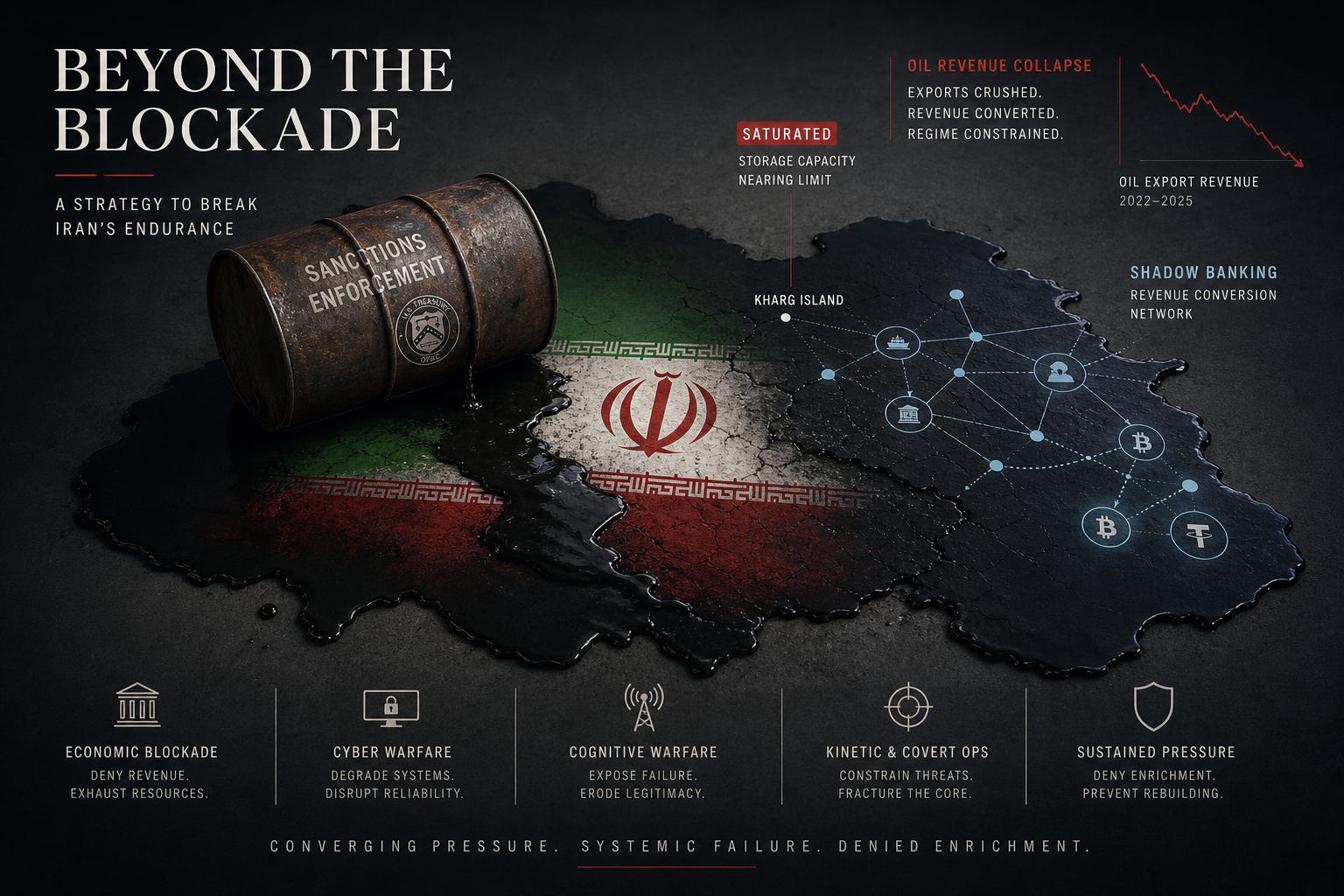
The United States and its partners’ air and maritime operations have significantly degraded Iran’s military infrastructure, missile production, and conventional capabilities. Yet the regime endures—and critically, it still retains an estimated 440 kilograms of highly enriched uranium, much of it enriched to roughly 60 percent and stored in hardened facilities such as Isfahan. This persistence reflects not strength, but design.
The regime’s survival rests on a clear center of gravity: its ability to convert constrained resources into usable power—financially, operationally, and politically. The regime does not need to prevail in conventional terms; it needs only to maintain internal control, manage pressure, and outlast its adversaries.
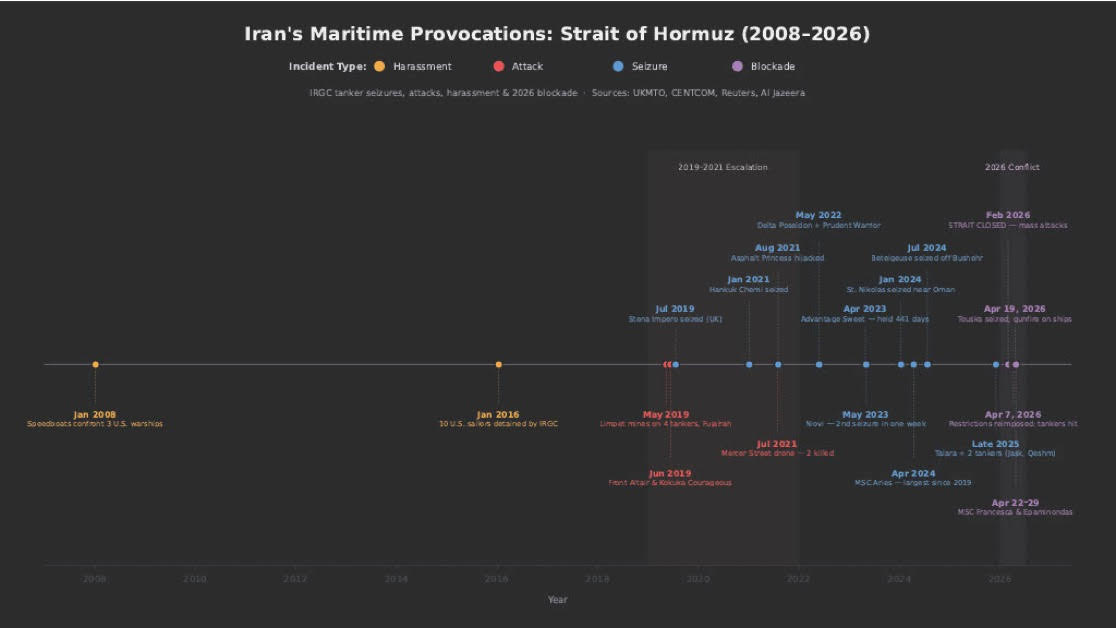
Externally, Tehran continues to weaponize geography as a source of strategic leverage—its ability to disrupt global energy flows through the Strait of Hormuz, a chokepoint carrying a substantial share of the world’s seaborne oil. This allows the regime to impose disproportionate costs on the international system while buying time to absorb pressure, stabilize internally, and adapt its survival strategy.
Internally, the system has hardened rather than fractured. The transition following the death of Ayatollah Ali Khamenei in February 2026 transformed Iran from a clerical-led system into a wartime security state dominated by the Islamic Revolutionary Guard Corps (IRGC). With traditional clerical mediation removed, the security elite now operates without moderating buffers—more ideological, more rigid, and more centralized. It controls not only coercive instruments, but also the financial, logistical, and digital architectures that sustain regime power, including illicit oil networks, shadow banking systems, and emerging cryptocurrency channels used to move sanctioned funds.
The implication is unmistakable: the IRGC is no longer merely defending the regime—it is the regime.
Defeating such an architecture requires more than continued military pressure. It demands a coordinated strategy of induced exhaustion—one that systematically dismantles the mechanisms that allow the system to endure.
The strategic objective remains unchanged. Iran must be compelled to abandon:
nuclear enrichment
ballistic missile development
sponsorship of proxy networks
coercive manipulation of the Strait of Hormuz
Achieving this outcome requires a synchronized campaign across five mutually reinforcing lines of effort—sequenced not simply to apply pressure, but to convert that pressure into systemic failure.
1. Economic Blockade — Collapse Revenue Conversion
Iran’s economy is structurally dependent on maritime trade, with more than 90 percent of its imports and exports transiting the Persian Gulf. Early disruptions revealed a key limitation: oil could still move, and revenue could still be generated.
The strategy has since shifted from disruption to systemic denial.
U.S. measures now target the entire value chain:
shadow fleet vessels
front companies and brokers
financial intermediaries
foreign buyers, including China-based “teapot” refineries
At the center of this system lies Iran’s shadow banking network, which converts illicit oil flows into usable state revenue. The battlefield has expanded from physical movement to financial conversion.
The decisive battleground is no longer the oil itself, but the system that turns it into power. Oil that moves but cannot be settled ceases to function as power.
As these channels constrict, Iran has adapted by expanding into cryptocurrency-based transactions through IRGC-linked exchanges. Yet this shift reflects constraint, not resilience. Crypto systems depend on liquidity, access points, and exchange infrastructure—all of which remain vulnerable. Crypto is not replacing Iran’s oil economy; it is compensating for its degradation.
More critically, financial pressure is now converging with a physical constraint: finite storage capacity.
Kharg Island, Iran’s primary export terminal, is nearing saturation. As exports collapse and monetization fails, unsold crude is accumulating across onshore tanks and offshore vessels. Once storage capacity is exhausted, Iran faces a binary choice: shut in production or risk permanent damage to aging oil fields.
The Defense Department estimates Iran has been denied nearly $5 billion in oil revenue because of the U.S. blockade, alongside long-term degradation of output capacity.
At the same time, the domestic economy is entering a destabilizing phase, according to the WSJ:
more than one million direct job losses, with another million indirectly affected
inflation approaching 69 percent, with food inflation exceeding 110 percent
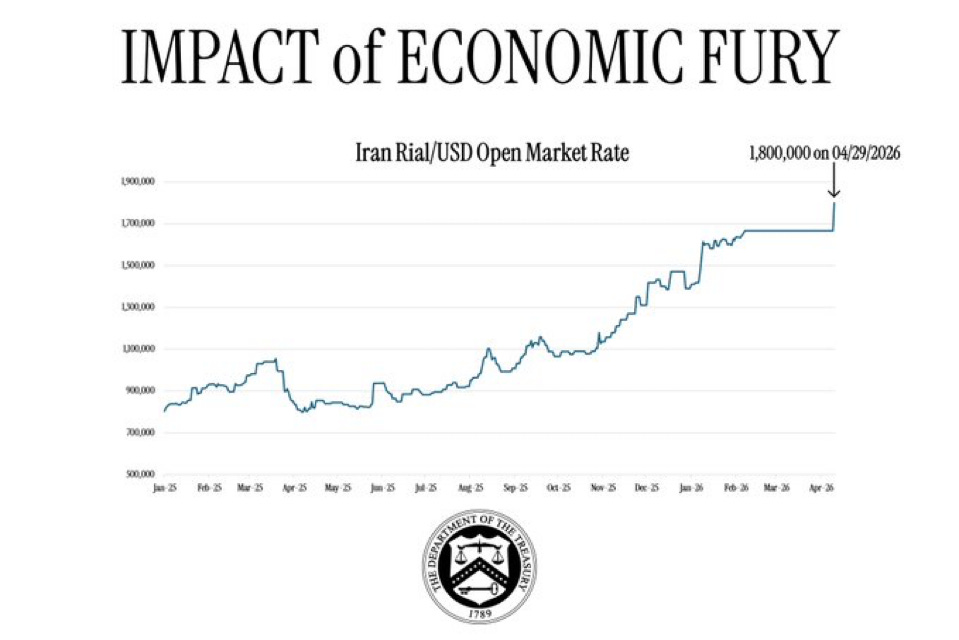
currency collapse to approximately 1.8 million rials per dollar
rising food insecurity, medicine shortages, and widespread business closures
The blockade is no longer merely constraining the regime—it is eroding the economic foundation on which its control depends.
2. Cyber Warfare — Degrade System Reliability
Economic pressure alone is insufficient if the regime retains the ability to function.
The IRGC’s endurance depends on the reliability of four interlocking systems:
wartime legitimacy management
financial conversion mechanisms
information control architecture
coercive apparatus coordination
Cyber operations must therefore evolve from episodic disruption to persistent, systemic degradation.
Priority efforts should focus on:
disrupting shadow banking and crypto transaction rails
degrading IRGC command-and-control systems
undermining surveillance infrastructure
penetrating propaganda and communications networks
Even decentralized financial systems rely on identifiable infrastructure and liquidity flows—points of vulnerability that can be targeted.
The logic is straightforward: when the regime cannot reliably move money, communicate orders, monitor society, or control its narrative, it cannot reliably exercise power.
The objective is not temporary disruption, but sustained operational friction—where every critical function becomes slower, less predictable, and more prone to failure.
3. Cognitive Warfare — Shaping the Informational Battlespace
Economic collapse does not automatically produce instability. It must be perceived, shared, and internalized.
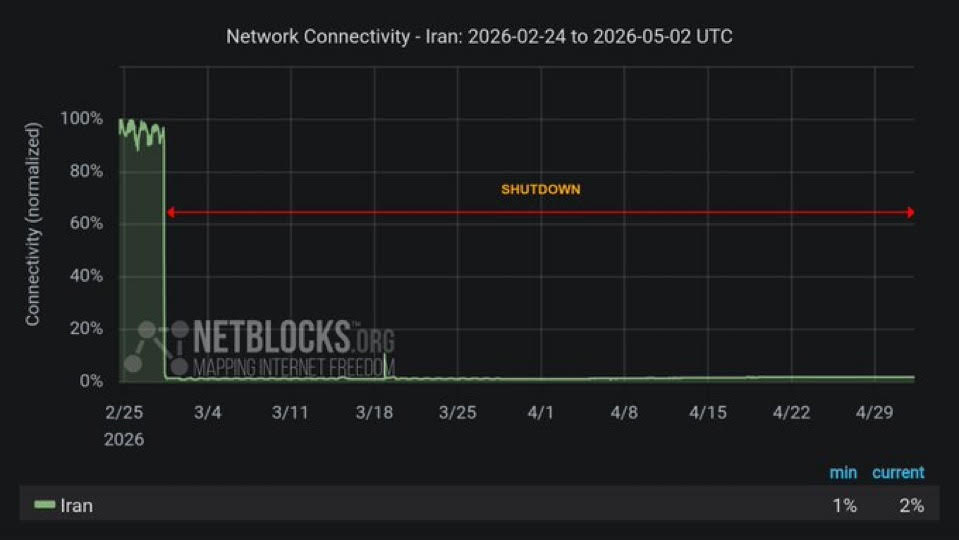
Iran’s prolonged internet blackout is not merely censorship—it is part of a closed-loop system of surveillance, control, and narrative management. The regime can observe society in real time while rendering society opaque to itself.
This asymmetry is decisive.
Information converts isolated grievance into shared awareness—and shared awareness into political risk.
Cognitive warfare must therefore break the regime’s monopoly over perception by exposing the widening gap between state narrative and lived reality:
economic deterioration driven by currency collapse
repression and coercive practices
elite privilege amid societal decline
The goal is not propaganda, but narrative correction.
When citizens recognize systemic failure—and recognize that others see it too—the cost of silence rises and the risk calculus shifts. Cognitive warfare transforms private hardship into shared understanding—and shared understanding into pressure.
4. Kinetic Containment — The Scalpel of Force
Military force remains necessary, but its role is no longer to drive the campaign.
It must operate alongside covert action as a unified line of effort:
overt force applied selectively to constrain
covert operations sustained to fracture
Kinetic force should:
prevent reconstitution of nuclear and missile capabilities
disrupt imminent threats
reinforce deterrence
Overuse risks strengthening regime cohesion.
Covert operations, by contrast, should target systemic vulnerabilities:
IRGC leadership and decision-making nodes
sanctions-evasion and procurement networks
financial intermediaries sustaining regime privilege
The goal is not symbolic decapitation, but functional disruption—introducing uncertainty, eroding trust, and increasing internal strain.
Together, these measures ensure the regime is progressively weakened from within.
5. Fracturing the Regime: The Security-State Dilemma
Iran is now an IRGC-centered security state. The removal of clerical mediation has eliminated internal moderating buffers, producing a system that is more rigid and less capable of compromise.
Recent diplomatic overtures—such as offers to ease pressure in the Strait of Hormuz in exchange for blockade relief—should be understood as tactical decompression efforts, not strategic concessions. They reflect pressure management, not transformation.
At the same time, the deepening economic crisis is creating elite scarcity. The regime must now make increasingly difficult trade-offs between:
funding internal security
maintaining basic services
sustaining external proxy operations
These pressures do not fracture the system immediately—but they increase internal strain and narrow strategic options.
Conclusion — Converging Pressure to Deny Enrichment
This strategy derives its power from convergence. Financial isolation constrains settlement; disruption of shadow banking severs revenue conversion; network denial restricts oil monetization; and storage saturation forces irreversible production decisions. Cyber operations degrade system reliability, while cognitive pressure erodes legitimacy.
Each constraint reinforces the next.
The objective is not immediate collapse, but strategic denial—forcing the regime into a position where it must choose between maintaining internal control and sustaining nuclear ambitions—and cannot do both.
For decades, Iran’s advantage was time. It absorbed pressure, adapted, and advanced. That advantage is now eroding. The convergence of financial, physical, and social pressures suggests the regime is approaching a non-linear threshold, beyond which continued enrichment becomes economically, operationally, and politically unsustainable.
To ease pressure now would not stabilize the situation—it would preserve a hardened, IRGC-dominated state with restored revenue, adaptive financial networks, and retained nuclear leverage.
Success should be measured not by regime collapse, but by the progressive loss of its ability to:
finance enrichment
sustain its nuclear infrastructure
maintain internal control
project power externally
The priority for U.S. policymakers is not escalation, but synchronization—sustaining pressure across domains until nuclear development is no longer a viable strategic option.
For decades, time enabled Iran’s nuclear progress. This strategy turns time into a constraint.
The question is no longer whether Iran can endure pressure, but whether it can continue to enrich under conditions that steadily dismantle the systems that make such endurance possible.