

Xi and Putin’s Alignment: A Stark Warning to U.S. Leadership from Kyiv to Taipei
How Xi’s appearance at Victory Day signaled China’s strategic alignment with Putin, reinforced an emerging authoritarian axis, and challenged U.S. global leadership.

"Strengthen coordination in order to decisively counter Washington's course of 'dual containment' of Russia and China." –Russia-China Joint Statement
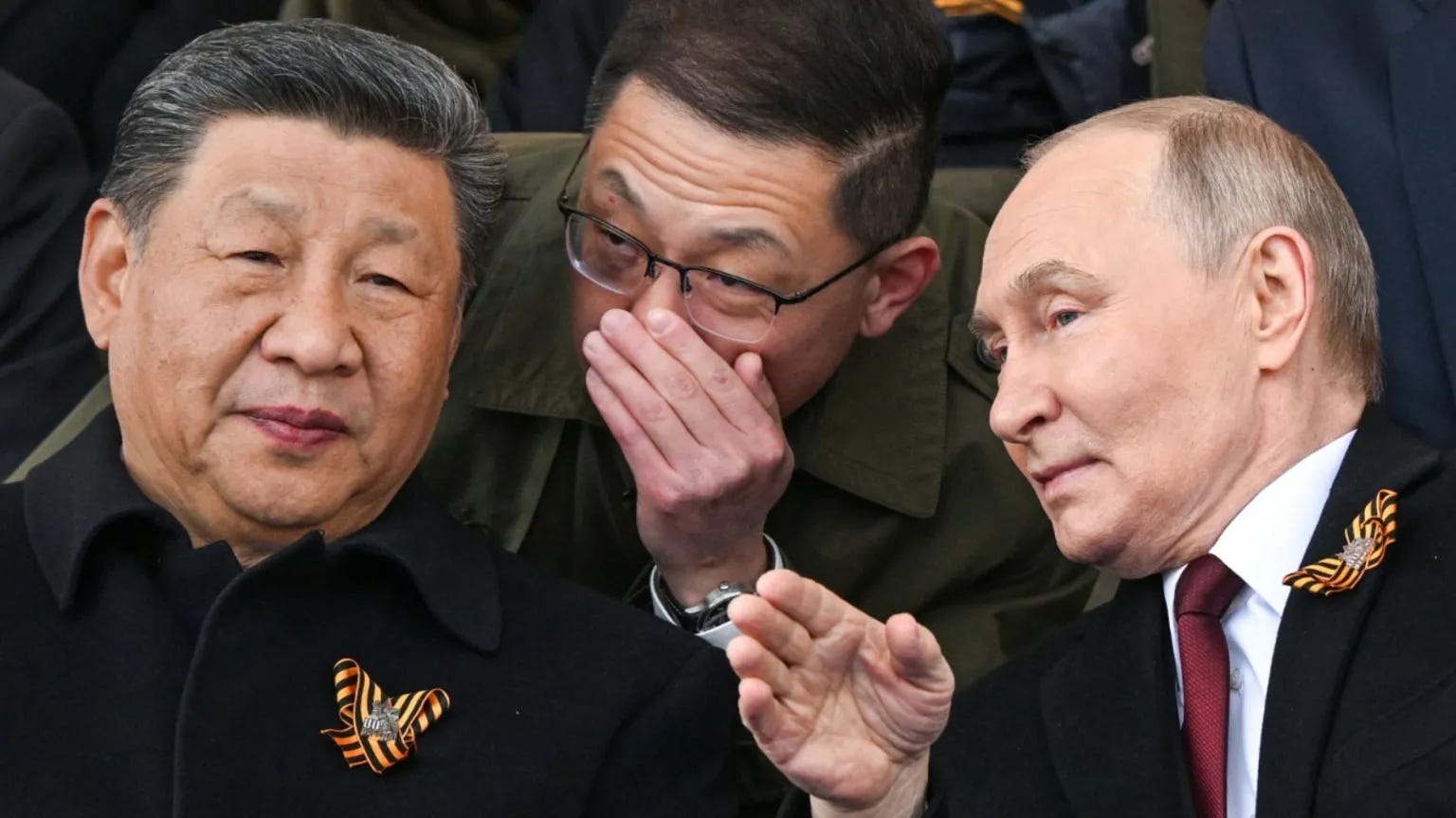
“This demonstration of unity served as a direct challenge to Washington's efforts to uphold the existing global order”
I. Executive Summary
President Xi Jinping's presence at Russia's Victory Day parade in Moscow on May 9, 2025, was far more than a ceremonial gesture. It represented a deliberate and potent geopolitical signal, underscoring the deepening strategic alignment between Beijing and Moscow amidst Russia's ongoing war against Ukraine. This demonstration of unity served as a clear message to Moscow of unwavering partnership, a direct challenge to Washington's efforts to uphold the existing global order, and a bid to position China as a leading force in a nascent multipolar world. Xi's participation, marked by rhetoric emphasizing an "unbreakable" bond and shared opposition to "hegemonism," carries significant implications for global deterrence, the potential consolidation of an authoritarian bloc, and the interconnectedness of security challenges in Europe and Asia. This report analyzes the multifaceted significance of this event, highlighting the strategic risks of Western inaction and proposing integrated recommendations for the United States and its allies to effectively counter these evolving dynamics and safeguard the liberal international order.
II. Xi's Moscow Attendance: A Deliberate Geopolitical Signal
A. Symbolism and Timing: Xi Jinping's decision to stand alongside Vladimir Putin at the Victory Day parade, commemorating the 80th anniversary of the Soviet triumph over Nazi Germany, was a carefully calculated act that extended beyond historical remembrance.1 The event, a cornerstone of Russian national identity and a powerful symbol of military strength, gained even greater geopolitical significance due to the ongoing war in Ukraine.2 Russia's diplomatic and economic isolation by the West further amplified the impact of Xi's presence, which conferred a degree of legitimacy on Putin's regime.3 This public display of solidarity occurred at a time when Russia's military campaign in Ukraine was facing considerable challenges and international scrutiny, suggesting China's willingness to align itself with Moscow despite these circumstances.4 The choice of this specific event, deeply embedded in Russia's historical narrative of resisting external aggression, sent a powerful message of shared historical interpretations and a united front against perceived external pressures.
B. Signaling to Moscow: Xi's attendance unequivocally signaled an unwavering partnership with Moscow in the face of extensive Western sanctions.5 By appearing at such a prominent event, Xi demonstrated that China stands firmly with Russia, positioning itself as a crucial strategic economic and diplomatic lifeline for a nation increasingly isolated by the West.6 The explicit articulation of an "unbreakable" bond and the aspiration for a relationship as strong as "friends of steel" further underscored this message of enduring support.7 This public affirmation of solidarity is particularly vital for Russia, as it demonstrates that its strategic pivot towards the East is yielding tangible and high-profile support, potentially mitigating the domestic and international impact of Western sanctions on the Russian economy and political stability.
C. Signaling to Washington: Xi's presence in Moscow served as a direct and open challenge to the United States' efforts to maintain global stability through its network of alliances, deterrence strategies, and the post-World War II international order.8 His rhetoric during the visit, which included veiled criticisms of "hegemonic bullying" and the "distortion of WWII's legacy," directly rebuked Western support for Ukraine and efforts to deter potential Chinese aggression in the Indo-Pacific region.8 This public alignment with Russia, a nation actively contesting the US-led order, indicated China's growing assertiveness and its willingness to openly challenge Washington's global leadership. It signaled Beijing's intent to create a multipolar world order, with Russia as a key strategic partner in this endeavor, thereby directly undermining the foundations of the existing international system.
D. Signaling to the Global South: Xi's participation in the Victory Day parade was also a calculated move to position China as a leader of an emerging multipolar order, one that stands in contrast to what Beijing frequently portrays as Western hegemony and historical revisionism.9 The attendance of other international leaders, such as Brazil's President Luiz Inácio Lula da Silva, further reinforced this message, suggesting a growing coalition of nations seeking alternatives to the Western-dominated global system.10 By showcasing solidarity with Russia, China aimed to project an image of strength and unity among nations of the Global South, offering an alternative model of international relations and development that resonates with countries seeking greater autonomy and less reliance on Western influence.
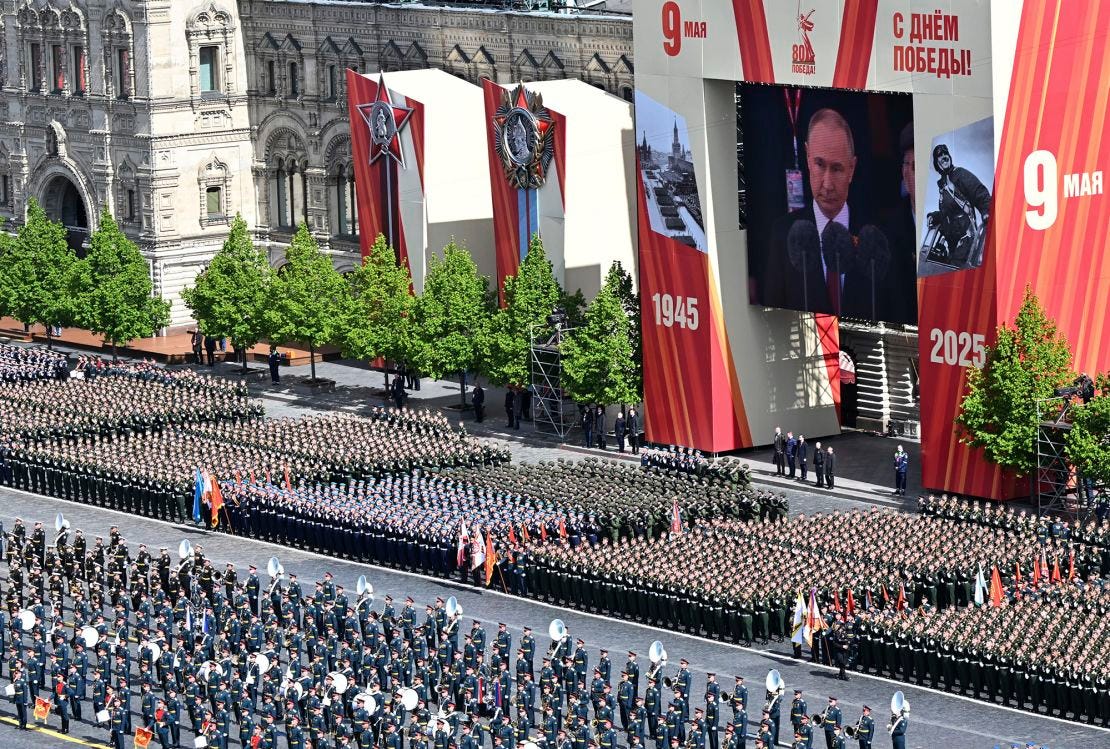
This alignment now extends beyond mere transactional interests in areas like energy and arms trade to encompass a more comprehensive shared worldview regarding the future of the international order
III. The Maturing China-Russia Strategic Partnership
A. Deepening Alignment: Xi's visit to Moscow and the subsequent joint statements issued with President Putin highlighted a significant deepening of the strategic convergence between China and Russia.11 This alignment now extends beyond mere transactional interests in areas like energy and arms trade to encompass a more comprehensive shared worldview regarding the future of the international order. While the "no limits partnership" declared previously might have been initially viewed with some skepticism, the continued high-level engagements and coordinated actions demonstrate a growing commitment to enhanced cooperation across a multitude of sectors, including increasingly sensitive areas like defense.12 The increasing frequency of these high-level meetings, coupled with the expansion of joint military exercises, points to a concerted effort to build not only interoperability but also a level of trust and strategic coordination that strengthens their ability to act in concert on the global stage.
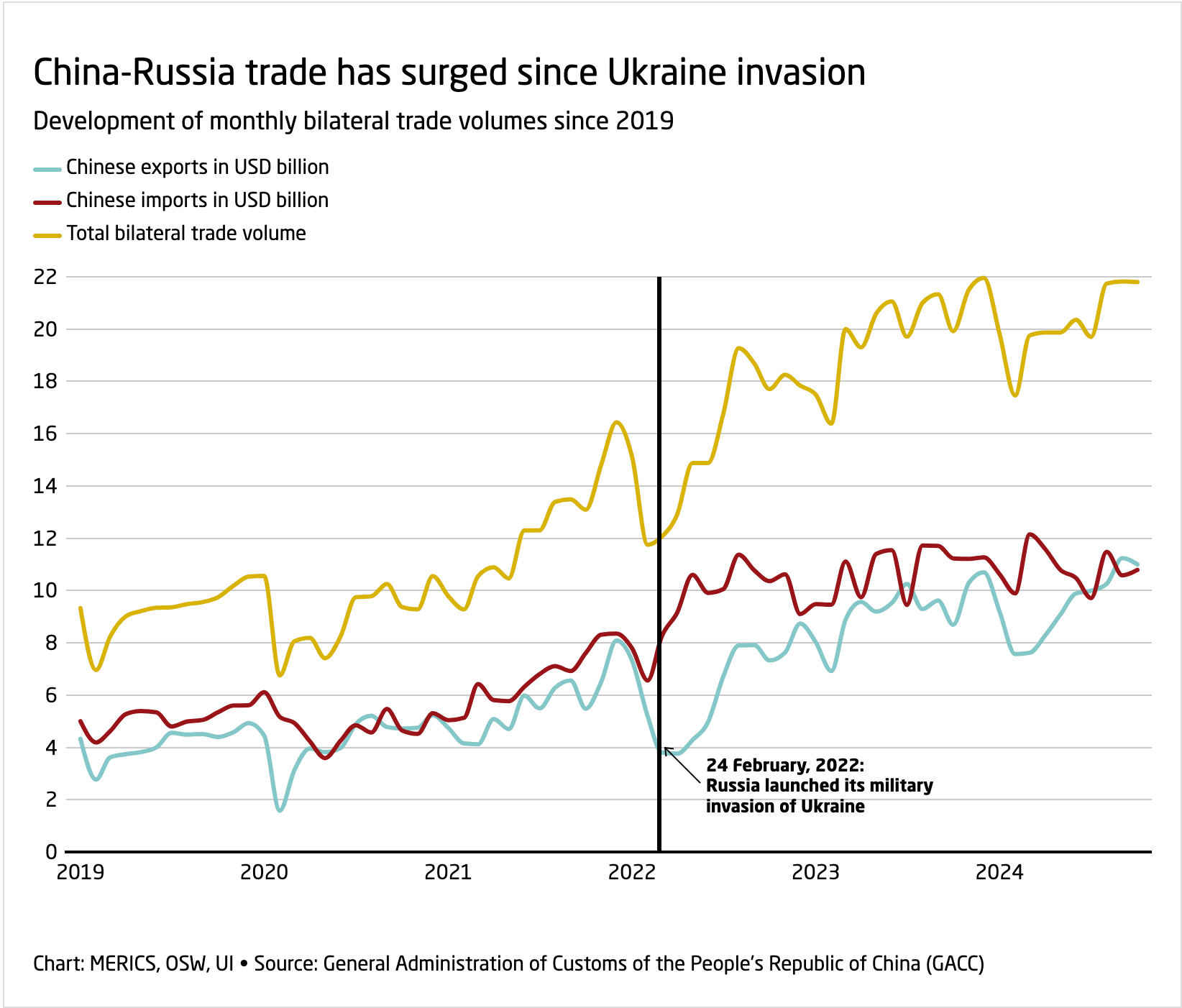
B. Economic Interdependence: China has solidified its position as a crucial market for Russian energy exports, providing a vital economic lifeline for Moscow as it faces extensive Western sanctions.13 This has become particularly important for Russia following the disruption of its energy exports to Europe. Simultaneously, Russia's reliance on China for a wide range of goods and components has grown significantly, especially those essential for sustaining its defense industry amid export controls imposed by Western nations.14 While this economic relationship exhibits an asymmetry, with Russia being considerably more dependent on China, it nonetheless strengthens the overall partnership by creating mutual economic stakes in its continuation. China benefits from access to discounted Russian energy resources, while Russia gains a critical market and a source of essential industrial inputs, contributing to the resilience of both economies in the face of sanctions and economic pressures such as tariffs.
C. Military and Security Cooperation: Joint military exercises between China and Russia have witnessed a notable increase in number, scale, and geographic reach since Russia's full-scale invasion of Ukraine.15 These exercises, spanning naval, air, and land domains, are no longer merely symbolic gestures but involve increasingly complex scenarios and a greater degree of interoperability between their armed forces. Beyond joint exercises, cooperation extends to joint technological development and even coordinated production of certain types of military equipment.16 While this relationship has not yet evolved into a formal military alliance with mutual defense obligations, the current level of military and security cooperation indicates a growing willingness to coordinate their military postures, share strategic intelligence, and potentially provide mutual support in specific regional or global scenarios, particularly in countering the perceived influence of the United States and its allies.
D. Shared Opposition to the US: A fundamental driving force behind the deepening strategic partnership between China and Russia is their shared opposition to what they perceive as the hegemonic role of the United States in global affairs and a mutual desire to reshape the existing international order.17 Both nations have consistently voiced criticism of Western support for Ukraine, viewing it as an example of external interference in the internal affairs of a sovereign state.18 This common strategic objective provides a robust foundation for their partnership, enabling them to coordinate their diplomatic and political efforts across various international forums, including the United Nations, to challenge US influence and promote their vision of a more multipolar world where their respective roles and influence are significantly enhanced.
IV. The Ukraine Conflict: A Crucible for Global Deterrence
This conflict serves as a crucial "proving ground" for the effectiveness of Western deterrence strategies
A. Ukraine as a Proving Ground: The ongoing war in Ukraine transcends the boundaries of a regional conflict; it has become a critical juncture in the broader global competition between democratic and authoritarian systems.19 This conflict serves as a crucial "proving ground" for the effectiveness of Western deterrence strategies and the international community's collective will to uphold fundamental principles of sovereignty, territorial integrity, and the rule of law.20 The manner in which this conflict concludes will have profound ramifications for the credibility of international law and the willingness of other authoritarian powers to contemplate and potentially execute similar acts of aggression against their neighbors.
B. Impact on Russian Military Capacity: The sustained provision of military, economic, and intelligence support by the United States and its allies to Ukraine is demonstrably depleting Russia's military capacity.21 This attrition not only directly assists Ukraine in its defense but also weakens a key component of the broader China-Russia-Iran-North Korea axis, thereby indirectly enhancing global security. The protracted nature of the conflict is placing a significant strain on Russia's finite resources, including manpower, advanced weaponry, and financial reserves, potentially diminishing its ability to project power and influence in other strategically important regions.22 Consequently, continued support for Ukraine presents a strategic opportunity to degrade the military capabilities of a major adversary without necessitating direct military intervention by the United States or its NATO allies.
C. Signaling to Beijing: The international community's response to Russia's aggression in Ukraine sends a critical and unambiguous signal to Beijing regarding the potential costs and consequences associated with any consideration of violent territorial revisionism, particularly in the context of Taiwan.23 A robust and unified international response, characterized by strong condemnation, coordinated sanctions, and sustained support for the victim of aggression, demonstrates that such actions will be met with significant international opprobrium and substantial economic and political repercussions.24 The level of Western resolve and commitment in supporting Ukraine's defense will directly and profoundly influence Beijing's strategic calculus concerning the feasibility and inherent risks of undertaking military action against Taiwan.
D. Reinforcing Allied Cohesion: The collective effort to support Ukraine in its struggle against Russian aggression has demonstrably strengthened allied cohesion across both the North Atlantic Treaty Organization (NATO) in Europe and among key partners in the Indo-Pacific region.25 This unified response has underscored the enduring importance of collective security arrangements in effectively deterring potential acts of aggression and maintaining regional stability in the face of significant geopolitical challenges.26 Conversely, any perceived failure to effectively support Ukraine or a wavering of resolve among Western allies would not only embolden potential adversaries but also fundamentally undermine the credibility and overall cohesion of the US-led alliance system on a global scale.
V. The Specter of a Functional Authoritarian Bloc
This emerging bloc, while not yet a formally codified alliance, represents a significant challenge to the liberal international order
A. Dual Anchors of an Alternative Order: Russia and China are increasingly functioning as the primary anchors of an alternative global order, one that stands in opposition to the democratic norms and the current structure of multilateral institutions.27 Their deepening strategic alignment provides a focal point and a source of encouragement for other authoritarian states around the world that seek to challenge the dominance of the US-led international system. This emerging bloc, while not yet a formally codified alliance, represents a significant challenge to the liberal international order by actively promoting alternative norms, values, and models of governance that prioritize state sovereignty and authoritarian control over democratic principles and individual freedoms.
B. Emboldened Rogue Regimes: The growing strategic alignment between China and Russia has emboldened other rogue regimes, most notably Iran and North Korea, to deepen their own levels of military and technological cooperation.28 These states, often facing international sanctions and diplomatic isolation, perceive the backing of powerful partners like China and Russia as an opportunity to advance their own strategic agendas and engage in more assertive and potentially provocative behavior on the international stage.29 This consolidation of an authoritarian network significantly increases the risk of regional instability, the proliferation of advanced weaponry, and the potential for coordinated actions that could undermine global peace and security.
C. Counter-Institutional Frameworks: The expansion and increasing prominence of multilateral organizations such as BRICS+ (Brazil, Russia, India, China, South Africa, plus new members) and the Shanghai Cooperation Organization (SCO), alongside initiatives like China's Belt and Road Initiative (BRI), represent the development of counter-institutional frameworks designed to dilute Western influence and potentially circumvent established sanctions regimes.30 These platforms offer alternative avenues for economic development, political cooperation, and security dialogue outside of the traditional Western-dominated institutions like the World Bank, the International Monetary Fund, and the G7.31 The growing interest and participation of non-Western nations in these frameworks signal a significant shift in the global landscape, reflecting a desire for a more multipolar and inclusive system of global governance.
D. Limits and Challenges: While the trend towards a functional authoritarian bloc is concerning, it is crucial to acknowledge that this network is not a monolithic entity and is characterized by inherent internal contradictions and competing national interests.32 Historical tensions, differing strategic priorities, and economic asymmetries among these nations can and do limit the extent and depth of their cooperation (e.g., China vs. India).33 The United States and its allies should therefore actively seek to understand and exploit these existing divisions, employing nuanced diplomatic strategies to prevent the formation of a truly cohesive and formidably potent anti-Western alliance.
VI. Strategic Risks of Western Inaction
Such a perception could embolden China to escalate its ongoing gray zone coercion tactics against Taiwan
A. China's Interpretation of Weakness: Any perceived wavering of Western resolve, particularly in the context of the war in Ukraine, such as pressuring Kyiv to accept territorial concessions, would be swiftly interpreted by Beijing as a significant sign of weakness on the part of the United States and its allies.34 Such a perception could embolden China to escalate its ongoing gray zone coercion tactics against Taiwan and potentially accelerate its timeline for more forceful measures aimed at achieving reunification.35 The outcome of the conflict in Ukraine will therefore have direct and profound implications for the security and stability of Taiwan and the broader Indo-Pacific region.
B. Allied Reassessment and Hedging: Should the United States and its allies be perceived as lacking the resolve to effectively support Ukraine in the face of Russian aggression, US allies in both Europe and Asia would likely undertake a critical reassessment of American reliability as a security guarantor.36 This could trigger hedging behaviors, where allies seek to diversify their security partnerships, or even lead to increased efforts towards security autonomization, where nations take greater responsibility for their own defense outside of traditional US-led alliances.37 Such a scenario would inevitably weaken the overall US-led alliance system and undermine collective security efforts in key strategic regions.
C. Escalation by Rogue Regimes: A perceived lack of Western resolve in the face of Russian aggression would likely embolden other rogue regimes around the globe to escalate their own provocative actions and destabilizing behaviors.38 These actors, observing a potentially weakened or indecisive response to Russia's actions, might become more confident that American deterrence lacks the necessary political durability and that they can pursue their own aggressive agendas with reduced fear of significant repercussions. This increased risk of escalation could lead to heightened regional instability and the potential for the outbreak of wider conflicts in various parts of the world.
VII. Debunking the Ukraine-vs-China Fallacy
A. Interconnected Deterrence: The notion that the United States must choose between prioritizing the conflict in Ukraine and focusing on competition with China in the Indo-Pacific rests on a fundamentally flawed premise.39 Deterrence is not a geographically compartmentalized concept; rather, the perception of resolve and commitment in one theater directly influences the calculations of potential adversaries in others.40 Demonstrating unwavering support for Ukraine against Russian aggression reinforces the credibility of US deterrence signals in the Indo-Pacific and vice versa. A perceived weakness in one region will invariably be interpreted as a broader lack of resolve, potentially emboldening adversaries across the globe.
B. Ukraine as a Cost-Effective Attrition Arena: Supporting Ukraine in its defense against Russia provides the United States and its allies with a remarkably cost-effective arena to attrit the military resources and international credibility of a major adversary.41 This is achieved without the need for direct US military deployment and the associated risks and costs. By enabling Ukraine to degrade Russia's military capabilities, the West is simultaneously weakening a key strategic partner of China, thereby indirectly benefiting US security interests in the Indo-Pacific. This strategic investment in Ukraine yields significant returns by diminishing the overall threat posed by the emerging authoritarian bloc.
C. Strengthening NATO and Resource Allocation: The war in Ukraine has served as a catalyst for the revitalization of the North Atlantic Treaty Organization (NATO), prompting increased defense spending and a renewed sense of purpose among European allies.42 A stronger and more capable NATO, taking on a greater share of the European security burden, ultimately enables the United States to more effectively allocate its resources and strategic attention towards the primary long-term challenge posed by China in the Indo-Pacific. A secure and stable Europe, underpinned by a robust NATO, enhances the overall strategic posture of the United States in its global competition with China.
D. Unity of Purpose and Consistent Commitment: The consistent and unwavering commitment of the United States and its democratic allies to supporting Ukraine against Russian aggression demonstrates a crucial unity of purpose.43 This unified stance reinforces the credibility of deterrence in both Europe and Asia, signaling to potential adversaries that the US and its partners are resolute in their commitment to upholding international law and defending the established global order against acts of aggression. Credibility and a demonstrated willingness to stand by core values are essential components of effective deterrence, and the situation in Ukraine serves as a critical test of this resolve.
VIII. Integrated Strategic Recommendations
A. Link Ukraine to Indo-Pacific Deterrence: Washington should explicitly and consistently frame its support for Ukraine as a critical component of its broader strategy to deter aggression in the Indo-Pacific, particularly concerning Taiwan.44 By clearly articulating that a failure to support Ukraine would embolden China and increase the risk of conflict in Asia, the US can build stronger domestic and international support for a comprehensive and integrated deterrence strategy that spans both European and Asian theaters.
B. Enhance Cross-Regional Alliance Coherence: The United States should actively work to deepen institutional linkages and enhance interoperability between key alliance structures such as NATO, AUKUS (Australia, United Kingdom, United States), and the Quad (United States, Japan, Australia, India).45 Promoting joint military exercises, facilitating intelligence sharing, and coordinating policy responses to shared threats across these regions will create a more synchronized and formidable deterrence posture against potential adversaries. A more integrated network of alliances will present a stronger and more unified front, complicating the strategic calculations of nations seeking to challenge the existing international order.
C. Impose Targeted Costs on Chinese Support to Russia: The United States and its allies must expand and rigorously enforce targeted sanctions and export controls on entities within China that are providing material support to Russia's war effort in Ukraine, particularly focusing on the provision of dual-use technologies and financial assistance.46 Clearly communicating the potential consequences of such support to Beijing, including the risk of broader economic and diplomatic repercussions, can create friction within the China-Russia partnership and limit Russia's capacity to sustain its aggression.
D. Expand Public Diplomacy: The United States needs to significantly expand and strategically refine its public diplomacy efforts to proactively counter the increasing spread of authoritarian narratives emanating from China and Russia.47 This involves reasserting the enduring value and benefits of democratic governance, transparency, and the rule of law as global public goods. Robust support for independent media outlets and civil society organizations around the world is crucial for effectively countering disinformation and promoting democratic ideals. Winning the battle of ideas is a fundamental component of long-term strategic competition.
E. Strengthen Economic Resilience and Diversification: The United States and its allies must proactively work to reduce their reliance on critical supply chains that either pass through or are controlled by potential adversaries.48 Promoting economic diversification, fostering stronger economic ties with allies and partners, and building more resilient and secure supply chains are essential components of a comprehensive national security strategy in an era of increasing great power competition.
IX. Conclusion
Xi Jinping's presence in Moscow on Victory Day 2025 was not merely a historical commemoration; it was a carefully orchestrated strategic move that signaled the increasing consolidation of an authoritarian vision for the distribution of global power.49 The outcome of Russia's war of aggression against Ukraine will have profound and far-reaching implications for the security of Taiwan and the future of the liberal international order.50 Victory for Ukraine, supported by sustained and resolute Western assistance, is not simply an idealistic aspiration but a fundamental geostrategic necessity.51 It serves to degrade an immediate threat, effectively deters the next potential aggressor, and upholds the very system that underpins global stability. In this unfolding contest of systems, the resolute defense of one democracy in Europe directly reinforces the credibility of defending all democracies, particularly in Asia. The message emanating from Moscow is unequivocal. The appropriate and necessary response from the United States and its allies must be equally unmistakable: a demonstration of integrated strength across all domains, unwavering and sustained resolve in the face of aggression, and consistent global leadership firmly anchored in democratic values and strategic clarity.
Sources:
https://clubedadoc.com/moscow-victory-day-parade-putin-xi-jinping-and-international-guests-celebrate
https://www.cbsnews.com/news/putin-russia-victory-day-2025-ukraine-china-xi-jinping/
https://gemini.google.com/app/3adb26d184bc65a2#:~:text=china%2Dxi%2Djinping-,Moscow%20Victory%20Day%20Parade%3A%20Putin%2C%20Xi%20Jinping%2C%20And%20International%20Guests%20Celebrate,-clubedadoc.com/moscow
https://www.cbsnews.com/news/putin-russia-victory-day-2025-ukraine-china-xi-jinping/
https://clubedadoc.com/moscow-victory-day-parade-putin-xi-jinping-and-international-guests-celebrate
https://clubedadoc.com/moscow-victory-day-parade-putin-xi-jinping-and-international-guests-celebrate
https://www.cbsnews.com/news/putin-russia-victory-day-2025-ukraine-china-xi-jinping/
https://www.oneindia.com/videos/putin-xi-jinping-victory-day-parade-moscow-011-4242998.html
https://clubedadoc.com/moscow-victory-day-parade-putin-xi-jinping-and-international-guests-celebrate
https://euromaidanpress.com/2025/05/08/russia-china-declare-joint-front-against-us-as-xi-wants-end-to-external-interference-in-moscow/
http://en.cppcc.gov.cn/2025-05/09/c_1091294.htm
https://clubedadoc.com/moscow-victory-day-parade-putin-xi-jinping-and-international-guests-celebrate
https://www.oneindia.com/videos/putin-xi-jinping-victory-day-parade-moscow-011-4242998.html
https://moderndiplomacy.eu/2025/01/02/brazils-brics-chairmanship-building-multipolar-world-remains-key-challenge/
https://www.cbsnews.com/news/putin-russia-victory-day-2025-ukraine-china-xi-jinping/
https://clubedadoc.com/moscow-victory-day-parade-putin-xi-jinping-and-international-guests-celebrate
https://euromaidanpress.com/2025/05/08/russia-china-declare-joint-front-against-us-as-xi-wants-end-to-external-interference-in-moscow/
http://en.cppcc.gov.cn/2025-05/09/c_1091294.htm
https://thediplomat.com/2025/05/the-duality-in-chinas-security-relations-with-russia/
https://euromaidanpress.com/2025/05/08/russia-china-declare-joint-front-against-us-as-xi-wants-end-to-external-interference-in-moscow/
https://merics.org/en/china-russia-dashboard-facts-and-figures-special-relationship
https://kinacentrum.se/en/publications/joint-military-exercises-signal-deepening-russia-china-strategic-alignment/
https://thediplomat.com/2025/05/the-duality-in-chinas-security-relations-with-russia/
https://kinacentrum.se/en/publications/joint-military-exercises-signal-deepening-russia-china-strategic-alignment/
https://kinacentrum.se/en/publications/joint-military-exercises-signal-deepening-russia-china-strategic-alignment/
https://clubedadoc.com/moscow-victory-day-parade-putin-xi-jinping-and-international-guests-celebrate
https://euromaidanpress.com/2025/05/08/russia-china-declare-joint-front-against-us-as-xi-wants-end-to-external-interference-in-moscow/
http://en.cppcc.gov.cn/2025-05/09/c_1091294.htm
https://cepa.org/comprehensive-reports/war-and-sino-russian-partnership-an-indispensable-but-uneasy-relationship/
https://clubedadoc.com/moscow-victory-day-parade-putin-xi-jinping-and-international-guests-celebrate
https://www.atlanticcouncil.org/in-depth-research-reports/issue-brief/to-secure-taiwan-the-united-states-must-first-secure-ukraine/
https://www.atlanticcouncil.org/in-depth-research-reports/issue-brief/to-secure-taiwan-the-united-states-must-first-secure-ukraine/
https://thediplomat.com/2025/03/china-watches-taiwan-learns-ukraines-war-and-the-indo-pacific/
https://www.newsweek.com/making-example-russia-ukraine-can-deter-china-invading-taiwan-opinion-1991525
https://clubedadoc.com/moscow-victory-day-parade-putin-xi-jinping-and-international-guests-celebrate
https://www.atlanticcouncil.org/in-depth-research-reports/issue-brief/to-secure-taiwan-the-united-states-must-first-secure-ukraine/
https://www.bushcenter.org/publications/americas-indo-pacific-alliances-are-vital-to-combating-beijings-influence
https://clubedadoc.com/moscow-victory-day-parade-putin-xi-jinping-and-international-guests-celebrate
https://www.aspistrategist.org.au/the-new-gang-of-four/
https://www.fpri.org/article/2025/03/russia-china-north-korea-relations-obstacles-to-a-trilateral-axis/
https://carnegieendowment.org/research/2024/10/cooperation-between-china-iran-north-korea-and-russia-current-and-potential-future-threats-to-america
https://clubedadoc.com/moscow-victory-day-parade-putin-xi-jinping-and-international-guests-celebrate
https://www.atlanticcouncil.org/in-depth-research-reports/issue-brief/to-secure-taiwan-the-united-states-must-first-secure-ukraine/
https://clubedadoc.com/moscow-victory-day-parade-putin-xi-jinping-and-international-guests-celebrate
https://www.fpri.org/article/2025/03/russia-china-north-korea-relations-obstacles-to-a-trilateral-axis/
https://carnegieendowment.org/research/2024/10/cooperation-between-china-iran-north-korea-and-russia-current-and-potential-future-threats-to-america
https://clubedadoc.com/moscow-victory-day-parade-putin-xi-jinping-and-international-guests-celebrate
https://www.atlanticcouncil.org/in-depth-research-reports/issue-brief/to-secure-taiwan-the-united-states-must-first-secure-ukraine/
https://www.newsweek.com/making-example-russia-ukraine-can-deter-china-invading-taiwan-opinion-1991525
https://www.atlanticcouncil.org/in-depth-research-reports/issue-brief/to-secure-taiwan-the-united-states-must-first-secure-ukraine/
https://www.atlanticcouncil.org/in-depth-research-reports/issue-brief/to-secure-taiwan-the-united-states-must-first-secure-ukraine/
https://clubedadoc.com/moscow-victory-day-parade-putin-xi-jinping-and-international-guests-celebrate
https://www.atlanticcouncil.org/in-depth-research-reports/issue-brief/to-secure-taiwan-the-united-states-must-first-secure-ukraine/
https://clubedadoc.com/moscow-victory-day-parade-putin-xi-jinping-and-international-guests-celebrate
https://www.bushcenter.org/publications/americas-indo-pacific-alliances-are-vital-to-combating-beijings-influence
https://thediplomat.com/2025/05/the-duality-in-chinas-security-relations-with-russia/
https://www.state.gov/acpd-official-meeting-minutes-january-16-2025/
https://www.state.gov/summary-of-january-2025meeting-understanding-chinas-public-diplomacy-efforts
https://www.csis.org/analysis/refocusing-us-public-diplomacy-multipolar-world
https://www.aspistrategist.org.au/the-new-gang-of-four/
https://www.spglobal.com/en/research-insights/market-insights/geopolitical-risk